Rhyming is simple — two words share the same ending sound, and something clicks in your brain. People search for words that rhyme with “one” for poems, songs, rap verses, captions, classroom work, and creative writing.
The word “one” sounds like /wʌn/, so you’re looking for that “-un” ending sound, not the “-one” spelling. This article gives you many rhyming words, explained and organized so you can actually use them.
Quick Answer: Top Rhyming Words for One at a Glance
These are the most common and useful rhymes. Start here.
- Sun
- Run
- Fun
- Done
- Gun
- Son
- Bun
- Nun
- Ton
- Won
- Spun
- Stun
- Shun
- None
- Pun
- Dun
- Hun
- Tun
Quick sentences:
- She was the one standing under the sun.
- The race was done before it had begun.
- We run just for fun, every single one.
- None could stun her once she had begun.
Perfect Words That Rhyme With One
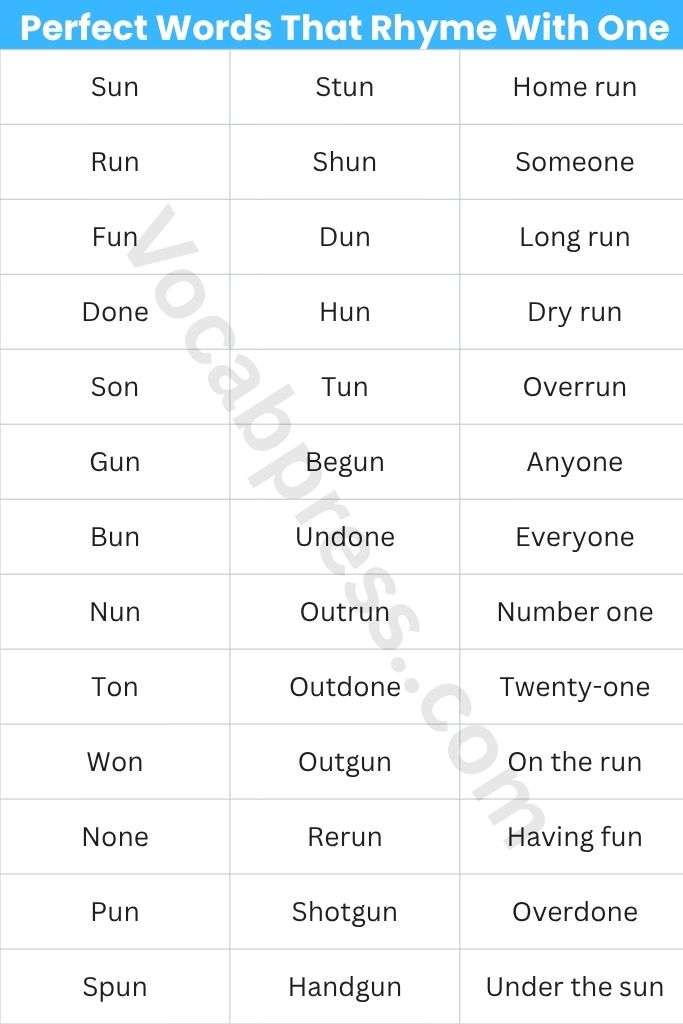
These share the exact /ʌn/ ending sound as “one.” Perfect rhymes are the safest choice for poems with strict rhyme schemes.
Common Rhyming Words for One :
- Sun — the star that gives us light and warmth
- Run — to move fast; also to manage something
- Fun — enjoyment, a good time
- Done — finished, completed
- Son — a male child
- Gun — a weapon; also used in idioms like “jump the gun”
- Bun — a small bread roll; also a hairstyle
- Nun — a woman living in a religious order
- Ton — a unit of weight
- Won — past tense of win
- None — not any, zero
- Pun — a joke using similar-sounding words
- Spun — past tense of spin; also means told a story a certain way
- Stun — to shock someone into silence or stillness
- Shun — to deliberately avoid someone
- Dun — a dull grayish-brown color; also means to demand payment
- Hun — informal word for a loved one
- Tun — a large wooden barrel used for storing liquid
Two-syllable perfect Words That Rhyme With One:
- Begun — the start of something, past tense of begin
- Undone — unfinished; also emotionally falling apart
- Outrun — to run faster than someone; to escape
- Outdone — surpassed, beaten at something
- Outgun — to have more firepower or strength
- Rerun — to run again; also a repeated TV episode
- Shotgun — a type of firearm; also calling the front seat
- Handgun — a small firearm held in one hand
- Home run — hitting the ball far enough to score in baseball
- Someone — a particular person, unspecified
- Long run — used in phrases like “in the long run”
- Dry run — a practice attempt before the real thing
Three-syllable perfect Words That Rhyme With One:
- Overrun — to spread beyond limits; overwhelmed
- Anyone — any person at all
- Everyone — all people included
- Number one — the best; first place
- Twenty-one — the number after twenty
- On the run — moving fast; fleeing from something
- Having fun — enjoying yourself actively
- Overdone — cooked too much; exaggerated beyond reason
- Under the sun — anywhere in the world; everything that exists
Near Words That Rhyme With One
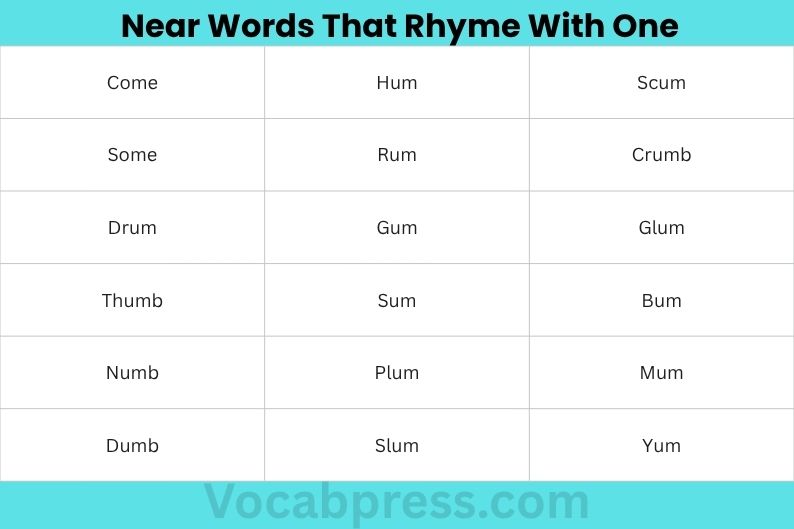
Near rhymes share part of the sound but don’t match exactly. They end in /ʌm/ instead of /ʌn/, which is close enough for songs, rap, and casual poetry.
- Come — to arrive or move toward something
- Some — a partial amount of something
- Drum — a percussion instrument; also to repeat something constantly
- Thumb — the short, thick finger on your hand
- Numb — unable to feel; emotionally shut down
- Dumb — unable to speak; also informal for unintelligent
- Hum — a low steady sound; to sing with closed lips
- Rum — an alcoholic drink made from sugarcane
- Gum — the pink tissue around your teeth; also chewing gum
- Sum — a total amount; the result of adding numbers
- Plum — a small purple or red fruit
- Slum — a poor, overcrowded area of a city
- Scum — a layer of dirty film on water; also an insult
- Crumb — a tiny piece of bread or food
- Glum — feeling sad or disappointed
- Bum — the back of the body you sit on; also a lazy person
- Mum — informal word for mother; also silent
- Yum — an expression of something tasting delicious
Why near rhymes work:
In rap and songs, the beat and melody carry the sound. A slight mismatch between /ʌm/ and /ʌn/ disappears when music is playing. Near rhymes also prevent writing from sounding too forced or predictable.
Slant Words That Rhyme With One
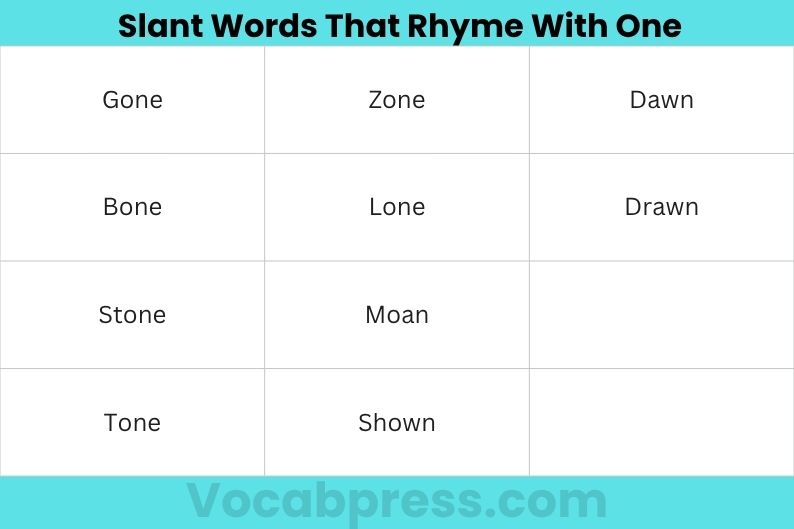
Slant rhymes share one sound but not the full ending. These appear more in modern poetry and give your writing a less expected feel.
- Gone — no longer present; disappeared
- Bone — a hard part of the skeleton
- Stone — a hard mineral rock
- Tone — the quality of a sound or color; also attitude in writing
- Zone — a defined area or region
- Lone — alone, without others
- Moan — a low sound of pain or unhappiness
- Shown — displayed, made visible
- Dawn — the beginning of the day, just before sunrise
- Drawn — pulled toward something; also created with pencil or pen
When to use slant rhymes:
Use them when perfect rhymes feel too neat or when you want your poem to breathe a little. A slant rhyme keeps rhythm without making every line sound the same.
Words That Rhyme With One by Number of Syllables
One Syllable — Sharp and Direct
These hit cleanly on a single beat. Perfect for punchy lines.
- Sun
- Run
- Fun
- Done
- Gun
- Son
- Bun
- Won
- Nun
- Ton
- Spun
- Stun
- Shun
- Pun
- Dun
- None
- Hun
- Tun
Two Syllables — Balanced and Flowing
These carry two beats. Great for mid-line rhymes or adding rhythm variation.
- Begun
- Undone
- Outrun
- Outdone
- Outgun
- Rerun
- Shotgun
- Handgun
- Someone
- Home run
- Long run
- Dry run
Three Syllables — Complex and Powerful
These work best in rap, slam poetry, and longer verse.
- Overrun
- Everyone
- Anyone
- Number one
- Twenty-one
- On the run
- Having fun
- Overdone
- Under the sun
Rhyming Words for One by Word Length
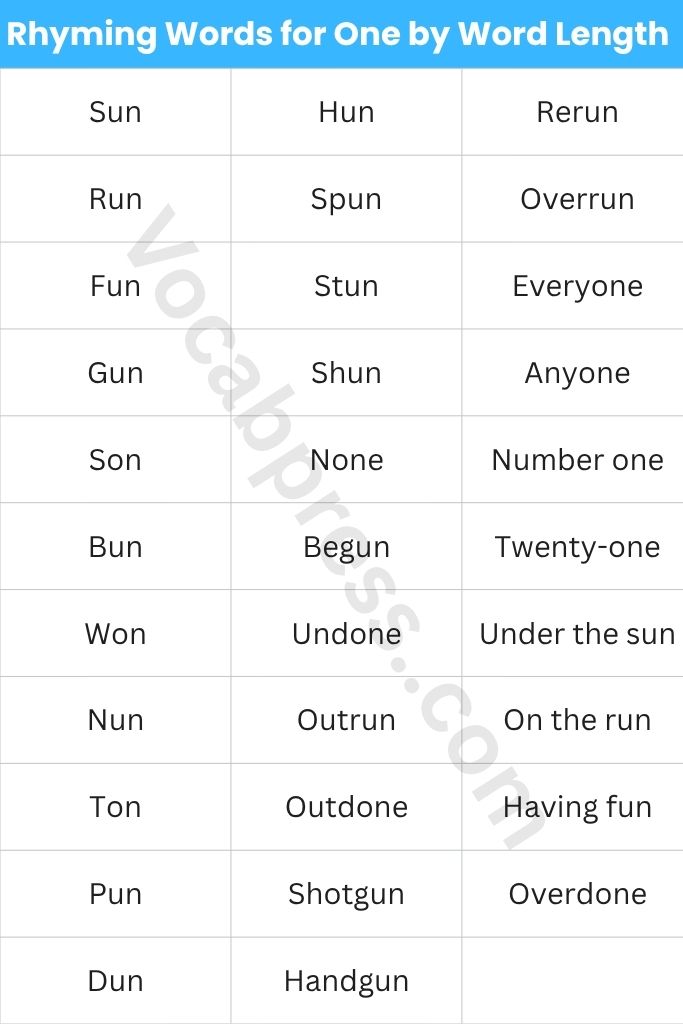
Short (3–4 letters):
- Sun
- Run
- Fun
- Gun
- Son
- Bun
- Won
- Nun
- Ton
- Pun
- Dun
- Hun
Medium (5–8 letters):
- Spun
- Stun
- Shun
- None
- Begun
- Undone
- Outrun
- Outdone
- Shotgun
- Handgun
- Rerun
Longer (9+ letters or phrases):
- Overrun
- Everyone
- Anyone
- Number one
- Twenty-one
- Under the sun
- On the run
- Having fun
- Overdone
Spelling Patterns and Pronunciation
“One” is spelled O-N-E but pronounced /wʌn/. This confuses people because they expect words ending in “-one” like bone or tone to rhyme — but they don’t. You’re chasing the sound, not the spelling.
Patterns that produce the /ʌn/ sound:
- -un — sun, run, fun, gun, bun, spun, stun, shun, dun, pun, nun, hun
- -on — son, ton, done, won, none (the letter “o” here makes the /ʌ/ sound)
- -onne — appears in some borrowed words, rare in everyday English
The rule: rhyme is about sound, not letters. “Son” and “sun” look different but sound identical. “Bone” and “one” look similar but sound nothing alike.
Homophones Connected to “One”
Some rhyming words sound exactly like other words with completely different meanings.
- Son / Sun — son is a male child; sun is the star in our sky. Same sound, different spelling, different meaning.
- Won / One — won is past tense of win; one is the number. They are homophones of each other.
- None / Nun — none means zero or not any; nun is a woman in religious life.
- Ton / Tun — ton is a unit of weight; tun is a large barrel for liquids.
When writing, context makes the meaning clear. But in captions or very short lines, double-check which spelling you need.
Read more: Words That Rhyme With Heart: The Only Guide You Need
Rhyming Words for One With Meanings (Extended List)
This section covers words not fully explained above.
- Spun — past tense of spin. Also used when someone shaped a story a certain way. “He spun the whole thing into a success story.”
- Stun — to freeze someone with shock or surprise. “The news stunned everyone in the room.”
- Shun — to actively avoid a person or group. “After the argument, they shunned him completely.”
- Pun — wordplay that uses similar sounds for a joke. “That pun was so bad it was actually good.”
- Dun — a flat, dull brownish-gray color. Also means to chase someone for money they owe.
- Begun — the starting point of something. “A journey of a thousand miles has begun.”
- Undone — something unfinished. Also describes a person emotionally unraveling.
- Outdone — beaten at one’s own game. “She outdone herself this time.”
- Overrun — spread past expected limits. “The garden was overrun with weeds.”
- Dry run — a rehearsal or test before the real event.
- On the run — moving constantly; escaping pursuit.
Rhyming Words for One Example Sentences
- Every plan she had was undone before it had truly begun.
- He outrun everyone on the track and still said it was just for fun.
- The sun had set, the day was done, and not a single race was won.
- She shunned the crowd, every last one, and sat alone beneath the sun.
- None of them knew the race had begun until he crossed the line and won.
- The city was overrun, the battle done, and no one under the sun had seen it coming.
- We started with none and built something — now we’re the ones everyone calls number one.
Rhyming Words for One Phrases Worth Using
These are natural, ready-to-use phrases — not random word combinations.
- Under the sun
- On the run
- Get it done
- Just for fun
- Having fun
- Hit and run
- The chosen one
- Number one
- All is done
- Good as done
- Only just begun
- Fight until it’s done
- Outrun, outgun, outdone
- All under the sun
- Born to run
Short Rhyming Words for One Lines
Ready for poems, songs, or captions — use as-is or adapt them.
- She was the one who made it fun.
- The battle’s done, the war is won.
- Run toward the sun, leave nothing undone.
- None could stun her once she’d begun.
- From zero to one, the race had begun.
- He spun a lie, she shunned the gun.
- We shine like the sun when all is done.
- Started with none, became the one.
- Born to run, afraid of none.
Funny Words That Rhyme With One
- My diet begun, then I ate a bun. Now it’s done.
- He tried to run from fun. That’s just dumb, son.
- The pun was done before it begun. I stunned everyone. Worth it.
- I’m number one at getting things undone before they’ve even begun.
- She grabbed the last bun. I had none. The war had begun.
Words That Rhyme With One Mini Poems
For Kids:
There’s only one sun up in the sky,
It shines all day as clouds roll by.
We run and play till day is done,
Nothing beats an afternoon of fun.
Motivational:
Every journey starts with one —
One step, one breath, and it’s begun.
Don’t stop before it’s done,
The hardest race is always the one you run.
Friendship:
You were the one who helped me run,
To chase the light instead of shun.
Now every hard thing feels less undone,
Because I have you, my favorite one.
Funny:
I tried to write a poem but hon,
My brain has spun, my wit is done.
I’ve used up every single pun,
And now I’ve run out of run.
Nature:
The river runs where rivers run,
From mountain snow to morning sun.
Each drop of water, every one,
Has somewhere far it must be gone.
Rhyming Words for One for Songs
Songs need words that feel natural when sung, not just when read.
Best picks for songs:
- Sun, run, fun, done — these four carry most pop and folk choruses
- Begun, undone — emotional, slower tracks, bridges, and final verses
- Someone, everyone, anyone — great for anthems and group moments
- Number one — confident, upbeat hooks
Why single-syllable words dominate songs:
They land cleanly on a single beat. “Fun” hits once. “Overrun” takes three beats. In a fast chorus, shorter words give the singer more control over delivery.
Song lines ready to use:
- We’ll chase the sun until we’re done
- You’re the one who makes life fun
- I’ve only just begun, I’ll outrun everyone
- Started with none, now we’ve already won
Rhyming Words for One for Rap
Rap rewards layering. Single rhymes get predictable fast — stacking and chaining keeps verses alive.
Basic chain:
- One / sun / run / gun / done / won / begun / undone / overrun
Internal rhyme example:
- “Son of a gun, on the run, having fun, number one — I already won and I’ve only just begun”
Multi-syllable stacking:
- “Overrun / everyone / anyone / begun / undone / outrun” — chain these for a rapid-fire section
Rap tips:
- Rhyme inside the line, not just at the end
- Mix one-syllable punches with two-syllable flows
- “Outrun, outgun, outdone” sounds like a complete thought, not just a list of rhymes
- Repeat sounds across lines, not just at line endings — that’s what separates basic from advanced
Rhyming Words for One for Captions
Instagram:
- “Chasing the sun, getting things done”
- “We’re the ones who make life fun”
- “Run wild. Shine bright. Be the one.”
- “Started from none, now we’ve won”
TikTok:
- “Started with none, ended with one”
- “Outrun, outdone, outshone — that’s the move”
- “Did it for fun. Now I’m done. Legend.”
Funny:
- “Thought I could run. I was wrong. Still number one though.”
- “Diet begun. Ate a bun. Diet done.”
Romantic / Aesthetic:
- “You’re the one my heart has always begun to love”
- “Every moment under the sun with you — never undone”
Kids Rhyming Words for One
Simple words for young readers and beginner writers.
Easiest rhymes with meanings:
- Sun — the big glowing star in the sky
- Run — moving fast on your legs
- Fun — something that makes you smile and laugh
- Bun — a small soft bread you eat
- Done — when something is all finished
- Son — a boy who belongs to a parent
- Won — when you win a game or race
Simple sentences for kids:
- The sun is warm and fun.
- We run and run until we’re done.
- One bun for everyone.
A short poem kids can memorize:
One, two, here comes the sun,
We laugh and play and have some fun.
When school is done, we run and run,
Goodnight to every single one.
Read more: Words That Rhyme With Me: Easy, Perfect, Near & Fun Words with Examples
Phonics Words That Rhyme With One
The /ʌn/ sound:
This is the vowel in “cup” or “up,” with an “n” on the end. Short, clean, and common.
Spelling patterns that make this sound:
- u + n → fun, run, sun, gun, bun, spun, stun, shun, pun, nun, dun
- o + n → son, ton, done, won, none (the “o” here sounds like “uh,” not “oh”)
Key phonics insight:
“One” doesn’t follow either pattern — it starts with a “w” sound even though it’s spelled O-N-E. Teach this early so kids stop expecting words that look similar to always sound similar.
Classroom activity:
Write this list on the board:
- sun, run, fun, bun, gun, son, done, won, none, one
Ask: which ones look the same? Which ones sound the same? Then ask: which one breaks the spelling rule? (“One” — because it starts with a /w/ sound.) That single conversation teaches spelling, phonics, and critical thinking at once.
Classroom Activities
Word sort:
Give students a mixed list — sun, bone, run, tone, fun, stone, done, gone. Ask them to sort into “rhymes with one” and “does not rhyme.” Words like “bone” and “tone” are traps that look related but aren’t.
Fill in the blank:
“The ______ came out and we had ______.” (sun / fun, or other combinations)
Multiple correct answers spark discussion.
Rhyme chain game:
One student says “one,” the next says “sun,” the next says “run,” and so on. Repeat a word or pause too long — you’re out.
Write your own verse:
Template:
“I am the ___ who loves to ___,
Beneath the bright and golden ___.”
Students fill in rhyming words and read them aloud.
Homophone card match:
Cards face down — flip and match “son” with its definition, then “sun” with its definition. Builds vocabulary alongside phonics understanding.
Positive Words That Rhyme With One
These carry upbeat, hopeful energy — useful for motivational writing, uplifting poems, and feel-good captions.
- Fun — joy and lightness
- Sun — warmth, hope, new beginnings
- Won — victory, achievement
- Begun — a fresh start, something new launching
- Run — action, movement, energy
- Done — the satisfaction of completing something
- Everyone — togetherness, inclusion
- Number one — confidence, being at your best
- Having fun — active enjoyment
- Home run — a big win, a success beyond expectations
Negative Rhyming Words for One
These carry weight and tension — useful for serious poems, conflict in stories, or emotional songwriting.
- Shun — rejection, being pushed away
- Gun — conflict, danger, aggression
- Undone — failure, falling apart emotionally
- None — emptiness, absence, loss
- Dun — dullness, dreariness, bleakness
- Outrun — fleeing, escaping something painful
- Overrun — overwhelmed, losing control
Writing tip:
Contrast works powerfully here. Pair “sun” with “shun,” or “fun” with “undone,” and you create emotional tension in just two words. That’s the kind of thing readers remember.
Emotional Rhyming Words for One
Love and Romance:
- You’re the one — direct and classic
- Begun — what love feels like at its start
- Sun — warmth, the way someone lights up your life
- Undone — what real love does to your defenses
Sadness and Loss:
- None — emptiness after someone leaves
- Shun — the feeling of being pushed away
- Undone — grief that unravels you
- Done — the finality of an ending
Friendship:
- Fun — the lightness of good company
- Run — loyalty, standing beside someone
- Won — winning together as a team
- Everyone — belonging, being included
Strength and Resilience:
- Outrun — rising above obstacles
- Begun — starting fresh after a hard time
- Done — proving you finished something difficult
- Overrun — pushing through when things pile up
Read also: Words That Rhyme With Home: Easy, Perfect, Songs, Kids & More
Best Rhyming Words for One by Category
For Kids and Beginners:
- Sun, Run, Fun, Bun, Done, Son, Won
For Poems:
- Undone, Begun, Sun, Shun, Won, None, Spun
For Rap:
- Overrun, Everyone, Anyone, Outrun, Outgun, Outdone, Number one, On the run
For Songs:
- Sun, Run, Fun, Done, Begun, Someone, Everyone
For Captions:
- Fun, Done, Sun, Won, Run, Number one, Started from none
For Motivational Writing:
- Begun, Won, Done, Outrun, Number one, Everyone, Under the sun
For Emotional Writing:
- Undone, Shun, None, Begun, Spun, Gun
Common Mistakes
Rhyming “one” with “bone” or “tone”:
These look like they should match because of the letter “o,” but the sounds are completely different. “One” = /wʌn/. “Bone” = /boʊn/. Not a rhyme.
Repeating the same rhyme word twice:
Using “done” twice in a short poem feels weak. The point of rhyming is variety within a pattern — rotate between sun, run, fun, done, won, and begun.
Forcing rare words:
“Tun” and “dun” are real words, but if your reader has to look them up, the rhyme breaks the flow. Use them only when the context genuinely fits.
Mixing up near rhymes and perfect rhymes:
“Come” and “some” are near rhymes, not perfect ones. They work in songs and rap but can feel slightly off in strict poem structures.
Homophone spelling errors:
Writing “sun” when you mean “son” changes the meaning of your entire line. Always check which spelling belongs in context.
Overloading a single line:
“He ran under the sun just for fun with his gun until it was done” — every word rhymes, but the line is exhausting. Space rhymes out naturally.
Words to Avoid or Use Carefully
- Tun — real word, but almost no reader knows it means a large barrel. If they have to Google your rhyme, the writing fails.
- Dun — works only in color descriptions or historical writing. Sounds forced in modern poems or songs.
- Hun — casual and warm in texts and captions, but too informal for serious writing.
- Yon — archaic word meaning “over there.” Only use if you’re deliberately writing in old-fashioned style.
FAQs
Does “done” actually rhyme with “one” even though the spelling is different?
Yes, completely. Rhyme is about sound, not letters. “Done” is pronounced /dʌn/ and “one” is pronounced /wʌn/ — both end in the /ʌn/ sound. The opening consonants are different, which is exactly how rhyme is supposed to work. Spelling is irrelevant here.
What’s the difference between “won” and “one” — can they rhyme with each other?
They’re homophones, meaning they sound exactly the same: /wʌn/. Because they’re identical in sound, they don’t truly rhyme with each other — rhyming needs two different words sharing an ending sound. But both words rhyme perfectly with sun, run, fun, done, begun, and the rest of the list.
What’s the best rhyme for “one” in a rap verse?
For a single-word impact, “done” or “gun” land hard. For multi-syllable flow, “overrun,” “everyone,” and “outrun” give you more beats to work with. If you want to sound advanced, chain them: “outrun, outgun, outdone — I already won.” That’s three rhymes stacked without repeating a word.
Can “come” or “some” work as rhymes for “one” in a poem?
They’re near rhymes, not perfect ones. In a relaxed free verse poem or a song, they pass easily because rhythm carries the sound. In a strict rhyme scheme — like a sonnet — careful readers will notice the slight mismatch. Whether to use them depends on how formal your piece is.
Summary
“One” is a small word with a lot of range. The words that rhyme with it — sun, run, fun, done, begun, undone, everyone, overrun — each bring their own energy and meaning. Some are punchy and short. Some carry emotional weight. Some are built for speed in a rap verse, and others slow down a poem just enough to let the feeling land.
Use this list as a toolkit, not a formula. Mix syllables, try near rhymes when perfect ones feel too tidy, and build phrases instead of just swapping single words. The strongest lines never sound like someone was hunting for a rhyme — they sound like the rhyme was always supposed to be there.

It’s Afini, I am the author at Vocab press, a website focused on animal facts with clear visuals and simple guides. I research and share accurate, easy-to-understand information for readers of all ages. My goal is to make learning about animals fun, trustworthy, and simple. I follow fact-based writing and keep content updated, helpful, and people-first. Thank you for reading.