Finding the right rhyming word changes everything. A poem lands better. A song chorus sticks. A rap line hits harder. A caption feels complete. “Down” is one of those words that carries real weight — and it has more rhyming partners than most people expect. This guide covers many words that rhyme with down, sorted by type and use, so you always pick the right one.
What Makes a Word Rhyme with “Down”?
“Down” ends with the -own sound — like the vowel in “cow” followed by an “n.” Say it slowly: d-OW-n. Perfect rhymes must match that exact ending sound. Words like “town” and “crown” hit it cleanly. Words like “ground” and “around” are close but shift slightly at the end — those are near rhymes, and they work great in songs and rap.
Perfect Words That Rhyme with Down — 1 Syllable
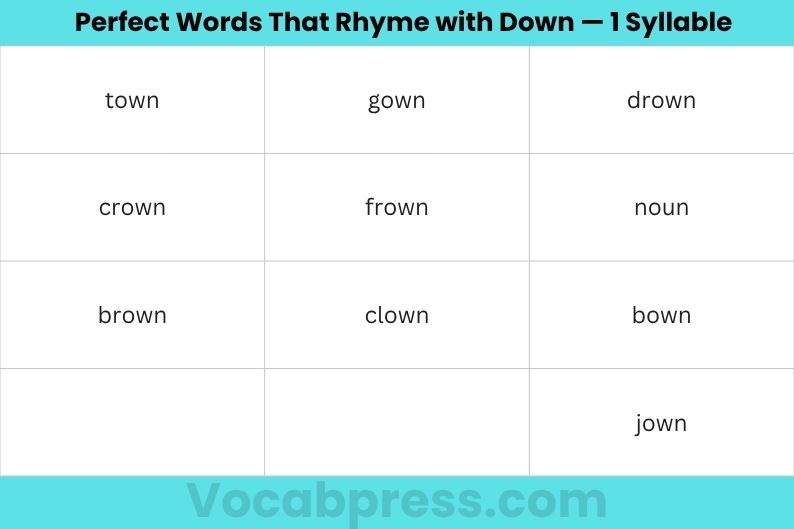
These are the cleanest, sharpest rhymes. Great for kids, beginners, poems, and song hooks.
- town — a place where people live, smaller than a city
- crown — a royal headpiece; also the top of something
- brown — a warm earthy color
- gown — a long dress or graduation robe
- frown — a face that shows sadness or disapproval
- clown — a funny performer; slang for someone acting foolish
- drown — to go under water and not survive; to be overwhelmed
- noun — a grammar word for a person, place, or thing
- bown — an old or dialectal form, rarely used today
- jown — regional slang, used in some dialects informally
Perfect Words That Rhyme with Down — 2 Syllables
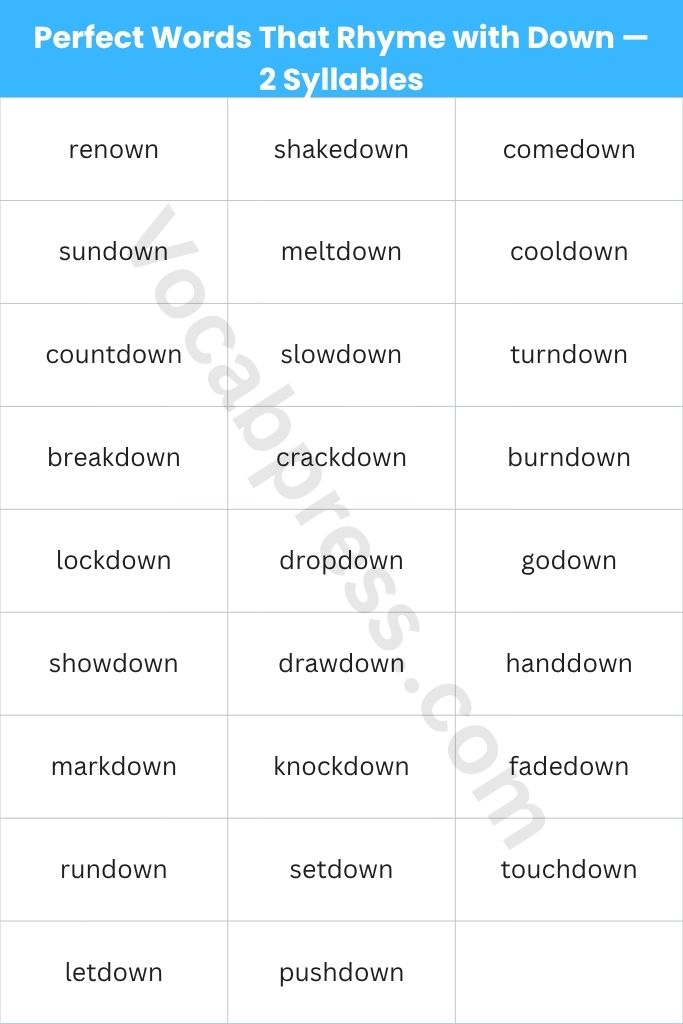
These carry more rhythm and work well in song verses, rap lines, and emotional poetry.
- renown — being widely known and respected
- sundown — the time the sun sets each evening
- countdown — counting backward before something starts
- breakdown — when something stops working; emotional collapse
- lockdown — when movement or activity is restricted
- showdown — a final face-off or moment of decision
- markdown — a reduction in price; also a text formatting style
- rundown — a quick summary; also worn-out or neglected
- letdown — a disappointment or feeling of being let down
- shakedown — a test run; also slang for extortion
- meltdown — a total loss of control or a nuclear disaster
- slowdown — a reduction in speed or activity
- crackdown — a strong effort to stop something
- dropdown — a menu that opens downward on a screen
- drawdown — a reduction in a military force or a resource level
- knockdown — hitting something hard enough to fall
- setdown — placing something carefully in a spot
- pushdown — pressing or moving something lower
- comedown — a drop in status or energy after a high
- cooldown — a rest period after exercise or activity
- turndown — a refusal; also folding something down
- burndown — reducing something until it is gone
- godown — a storage warehouse, used mostly in South Asia
- handdown — passing something from one generation to the next
- fadedown — a gradual decrease in sound or light
- touchdown — scoring in football; also when a plane lands
- sundown — the peaceful end of the day (listed above but worth noting in compound context too)
- rundown — see above; also the state of being exhausted
Read more: Words That Rhyme With One: For Poems, Songs, Kids, and Writing
Perfect Words That Rhyme with Down — 3 Syllables
These longer rhymes are rare and powerful. A skilled poet or rapper uses them to surprise the reader.
- eiderdown — soft feathers from an eider duck, used in quilts
- tumbledown — old, falling apart, barely standing
- upside-down — flipped the wrong way; chaotic or reversed
- shantytown — an area of makeshift or poorly built homes
- dressing-gown — a loose robe worn at home before getting dressed
- elderdown — a variant reference to soft feather fill material
- clampdown — a strict crackdown on behavior or activity
- goose-down — the soft under-feathers of a goose, used in bedding
Near Words That Rhyme with Down
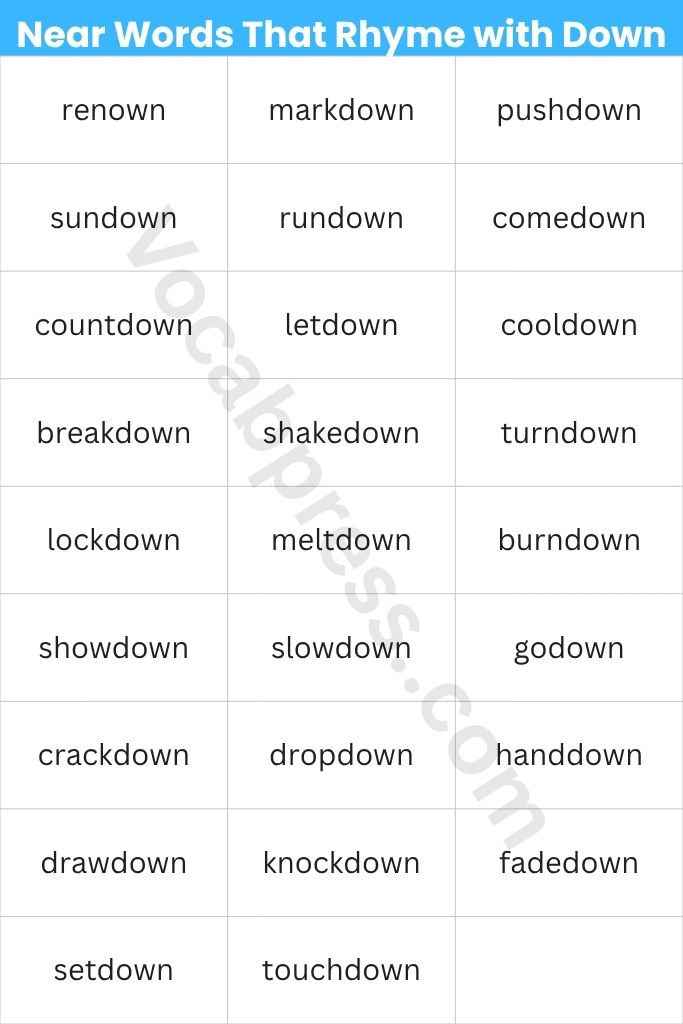
Near rhymes share the same vowel sound but end with a slightly different consonant — “nd” instead of “n.” They are used constantly in rap, pop songs, and modern poetry because they feel natural without feeling forced.
- round — circular; also a turn or period in a game
- sound — a noise; also healthy or solid
- ground — the surface of the earth; also to punish by limiting freedom
- found — discovered; past tense of find
- bound — tied up; also heading in a direction
- mound — a small hill or pile
- pound — to hit hard; also a unit of weight or British currency
- hound — a hunting dog; to chase or bother someone
- wound — an injury (pronounced “woond”); also wrapped around something
- around — on all sides; in a circle
- profound — very deep in meaning or feeling
- surround — to go all the way around something
- rebound — bouncing back; recovering from a loss
- background — what is behind the main subject
- compound — a mixture; also an enclosed area
- playground — a place for kids to play
- underground — below the surface; also secretive or alternative
- aground — stuck on the bottom, as in a ship
- expound — to explain something in detail
- astound — to shock or amaze someone
- dumbfound — to leave someone speechless with surprise
- resound — to echo loudly and clearly
- spellbound — completely captured by something, unable to look away
Read more: Words That Rhyme With Home: Easy, Perfect, Songs, Kids & More
Slant Words That Rhyme with Down
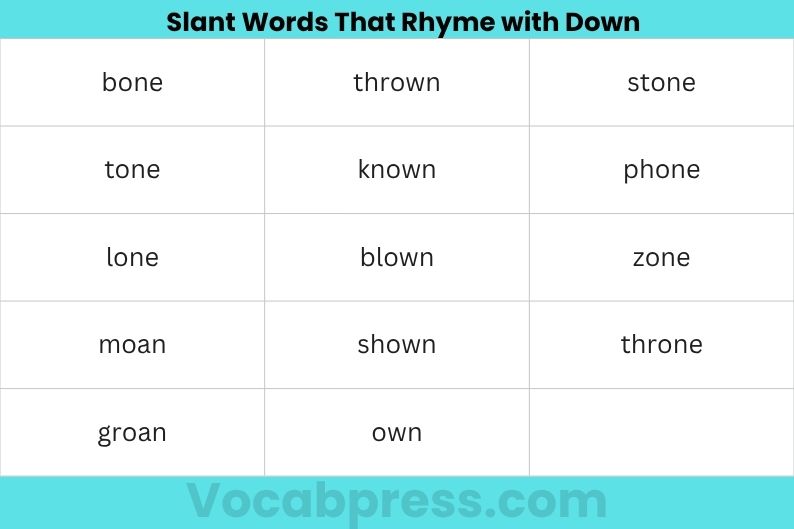
Slant rhymes share some sound with “down” but not all. They work in experimental poetry and creative writing where you want something unexpected.
- bone — shares the “n” ending, different vowel
- tone — the mood or quality of something
- lone — alone, solitary
- moan — a low sound of pain or sadness
- groan — a deeper sound of effort or displeasure
- thrown — past tense of throw
- known — recognized or familiar
- blown — moved by wind; also past tense of blow
- shown — past tense of show
- own — to possess something (note: this does NOT perfect-rhyme with down — the vowel is different)
- stone — a hard natural rock
- phone — a device for communication
- zone — a defined area or region
- throne — the chair of a king or queen
Rhyming Words for Down Example Sentences
- She walked through the quiet town wearing a long white gown.
- He lost his crown somewhere between the palace and the sundown.
- Every countdown feels like a meltdown when you are not ready.
- The old building looked completely tumbledown but still had its renown.
- A clown in a brown coat sat down in the middle of town.
- After the showdown, there was nothing left but a ghost town.
- The lockdown turned the whole city into a slowdown.
- She wore her gown like it was a crown — quiet and certain.
- The breakdown came right after the countdown hit zero.
- He grew up in a shantytown and built his own renown.
Rhyming Words for Down Phrases Ready to Use
These short phrases drop into poems, lyrics, or captions without any extra work:
- “lost in this town / wearing a frown”
- “the sun goes down / across the brown”
- “slipping through the cracks of a rundown town”
- “from the crown to the ground”
- “don’t you dare drown / in a borrowed gown”
- “the whole countdown / felt like a meltdown”
- “a clown in a gown in the middle of town”
- “chasing renown in a tumbledown town”
- “watch the sun fade at sundown / on the edge of this old town”
Short Rhyming Words for Down Couplets
- She walked alone through the sleeping town / with tired eyes and a quiet frown.
- The king removed his heavy crown / and watched the golden sun go down.
- He wore his gown and earned his renown / on a cold morning in a small town.
- The countdown ticked, the walls came down / and no one wore a smile or crown.
- A clown came in, set everything down / and somehow turned the whole mood around.
Funny Rhyming Words for Down
- The clown wore a gown to the edge of town / and tripped on his shoes going upside-down.
- The king lost his crown all over town / found it in a puddle, soaking brown.
- My cat sat down, gave me a frown / then knocked my whole breakfast down.
Read also: Words That Rhyme With Go: Complete List, Examples and Rhyming Guide
Rhyming Words for Down Mini Poems
For Kids
Little bear sat down
In a coat of brown
She wore no crown
Just smiled at the town
Nature
The sun sinks low at sundown
Painting gold across the brown
The trees bow gently down
As night wraps up the town
Friendship
When your whole world falls down
And you wear nothing but a frown
I will show up in your town
And lift you off the ground
Motivational
Every countdown ends
Every wall comes down
You do not need a crown
To rise above this town
Funny
I wore my gown to town today
The people stared, I have to say
A clown walked by and waved my way
We both just laughed and called it a day
Words That Rhyme with Down for Songs
In a song, the vowel sound gets stretched when sung. “Down” becomes “dow-ow-own.” Every perfect rhyme does the same, which is why they feel so natural together.
- For pop choruses: town, crown, gown, renown — singable, open, emotional
- For ballads: sundown, letdown, fadedown — soft and slow, good for holding a note
- For energetic choruses: countdown, breakdown, meltdown — sharp and punchy
Near rhymes like “ground” and “around” work perfectly in verses. Save the perfect rhymes for the hook where it needs to land cleanly.
Rhyming Words for Down for Rap
Rap rewards multi-syllable rhyme chains. Here is how to build one using “down” rhymes:
Simple chain:
down → town → crown → renown → sundown
Power chain (2–3 syllables):
breakdown → countdown → meltdown → lockdown → crackdown → slowdown
Internal rhyme line example:
“From a rundown town I built my renown, stood my ground, turned it all around.”
This line uses perfect rhymes (town/renown), near rhymes (ground/around), and internal rhyme — all in one line. That is the skill level rap rewards.
Words That Rhyme with Down for Captions
Aesthetic / Instagram:
- “sun going down on a quiet brown town 🍂”
- “she wore her gown like her own crown”
TikTok / Funny:
- “countdown to another meltdown 😂”
- “looked like a clown, felt like a clown, definitely was the clown”
Romantic:
- “you walked into my town and turned my frown right around”
Motivational:
- “every breakdown is just a countdown to something better”
Kids and Phonics Rhyming Words for Down
Easy words with simple meanings:
- down — opposite of up
- town — where people live and shops are
- brown — the color of wood and chocolate
- crown — a hat for a king or queen
- frown — a sad face
- clown — a funny person who makes you laugh
- gown — a fancy long dress
- drown — going under water and not being able to breathe
Simple reading practice for beginners:
The clown sat down.
He had a frown.
He wore a brown gown.
He lived in town.
The sound to know: The vowel in “down” is called the OU diphthong, written as /aʊ/ in phonics. Your mouth starts open and your lips round at the end. Practice: cow — how — now — down — town — crown.
Spelling patterns:
- -own spelling: down, town, crown, brown, gown, frown, clown, drown
- -oun spelling: noun, renown, mound, sound
Big trap: “own” as in “I own a car” sounds like /oʊn/ — not /aʊn/. It does NOT rhyme with “down.” This confuses beginners every time.
Classroom Activity Ideas
Matching cards: Write pairs on index cards — crown/town, gown/frown, clown/down. Students flip and match.
Fill in the blank:
- “The king lost his ______ in the middle of ______.” (crown / town)
- “She gave a big ______ when the sun went ______.” (frown / down)
Sorting game: Give 20 words — some rhyme with “down,” some do not. Students sort into two columns.
Rhyme chain circle: One student says “down,” next says “town,” next says “crown” — keep going until no one can add a new word.
Write a couplet: Each student writes two lines where the last word rhymes. No topic rules — just make the ending words match.
Rhyming Words for Down Grouped by Emotion
Happy / Hopeful
- renown
- crown
- countdown (toward something good)
- touchdown
- sundown (peaceful close of day)
Sad / Heavy
- frown
- drown
- breakdown
- meltdown
- letdown
- fadedown
Playful / Funny
- clown
- upside-down
- tumbledown
Romantic
- gown
- crown
- sundown
- renown
Common Mistakes
Using “own” as a rhyme for “down”
The vowel sounds are different. “Own” = /oʊn/. “Down” = /aʊn/. They do not rhyme. This is the single most common mistake.
Overusing “town” and “crown”
Both are great words but leaning on just two rhymes makes writing feel lazy. Rotate in “renown,” “sundown,” “countdown,” or “tumbledown.”
Treating near rhymes as perfect rhymes
“Sound” and “ground” are near rhymes. They work in songs and rap. In strict formal poetry, they do not count as exact rhymes. Know the difference before you use them.
Repeating the same rhyme word
Three lines ending with “town” kills the energy. Build a chain — town, crown, sundown, meltdown — and keep it moving.
Forcing a long word where a short one fits
“Eiderdown” is a beautiful word, but if your line is short, it crowds everything. Match the length of the rhyme to the length of the line.
FAQs
Does “around” rhyme perfectly with “down”?
No — it is a near rhyme. The vowel matches but the ending shifts from “n” to “nd.” It works well in rap and modern songs but not in strict formal poetry.
Can “noun” be used as a rhyme for “down” in serious poetry?
Yes, and it is a great choice. It is a perfect rhyme and unusual enough to surprise a reader without feeling wrong. A poem that pairs “noun” with “down” stands out from the crowd.
What is the strongest rhyme for “down” in a song chorus?
“Town” and “crown” carry the best singable quality. The open vowel holds when a singer stretches a note. For a slower ballad, “renown” works beautifully because the second syllable gives it space.
Why do compound words like “breakdown” count as rhymes for “down”?
English rhyme works on the final stressed syllable and everything after it. “Breakdown” ends with the stressed syllable “down” — so it rhymes cleanly with “town,” “crown,” and “frown.” The prefix does not change the ending sound at all.
Summary
“Down” opens up more rhyming options than it first appears. From sharp one-syllable words like “town,” “crown,” and “frown,” to expressive compound words like “meltdown,” “showdown,” and “countdown,” to rare poetic gems like “tumbledown” and “shantytown” — there is a rhyme here for every format and every feeling. Near rhymes like “ground” and “around” give extra flexibility for songs and rap.
Slant rhymes like “tone” and “groan” add texture to experimental poetry. The words that rhyme with down number well over a hundred once you count every type — and this guide gives you all of them, with meaning and context, so you never have to guess which one fits.

It’s Afini, I am the author at Vocab press, a website focused on animal facts with clear visuals and simple guides. I research and share accurate, easy-to-understand information for readers of all ages. My goal is to make learning about animals fun, trustworthy, and simple. I follow fact-based writing and keep content updated, helpful, and people-first. Thank you for reading.