Finding the right rhyme for “blue” can make or break a poem, song lyric, caption, or rap verse. The word “blue” ends in the /uː/ sound — clean, open, and easy to match. But most people get stuck after “true” and “you.” This article gives you many rhyming words, sorted by type, syllable count, use case, and meaning, so you always have exactly what you need.
Quick Answer: Best Words That Rhyme With Blue
These are the most natural, commonly used rhymes — great starting points for any writing:
- clue
- true
- new
- you
- grew
- knew
- view
- through
- dew
- few
- do
- who
- two
- shoe
- zoo
- flew
- glue
- hue
- crew
- brew
Quick sentences:
- The sky turned blue and nobody had a clue.
- She stayed true through everything she went through.
- Morning dew made the garden look brand new.
Perfect Words That Rhyme With Blue — Complete List

These all share the exact /uː/ ending sound as “blue.”
One-Syllable Perfect Rhymes
- blew
- blue (the base word)
- brew
- chew
- clue
- coo
- coup
- crew
- cue
- dew
- do
- drew
- due
- ewe
- few
- flew
- flu
- flue
- glue
- gnu
- grew
- goo
- hew
- hue
- jew
- knew
- lieu
- mew
- moo
- new
- pew
- phew
- pooh
- q
- queue
- rue
- screw
- shew
- shoe
- shoo
- shrew
- skew
- slew
- spew
- stew
- strew
- sue
- threw
- through
- to
- too
- true
- two
- view
- whew
- who
- woo
- yew
- you
- zoo
Two-Syllable Rhymes for Blue
- accrue
- ado
- anew
- askew
- bamboo
- bayou
- bestow (near)
- bijou
- boo-boo
- breakthrough
- buckwheat (near)
- cacao
- canoe
- cashew
- choo-choo
- construe
- couture (near)
- cuckoo
- debut
- ensue
- eschew
- fondue
- groundbreaking (near)
- guru
- haiku
- hairdo
- hallowed (slant)
- hindu
- imbue
- into
- issue (near)
- jackaroo
- jujube (near)
- kazoo
- kung fu
- lulu
- miscue
- outdo
- outgrew
- overdue
- peru
- preview
- pursue
- renew
- rescue (near)
- review
- revue
- shampoo
- sinew (near)
- subdue
- taboo
- tattoo
- tissue (near)
- tofu
- undo
- unscrew
- unto
- value (near)
- venue (near)
- virtue (near)
- voodoo
- wahoo
- withdrew
- yahoo
- yoga (slant)
- zombie (slant)
Three-Syllable Rhymes for Blue
- avenue
- barbecue
- bienvenue
- boogaloo
- carousel (near)
- cockatoo
- continue
- corkscrewed (near)
- couscous (near)
- derring-do
- didgeridoo
- dillydoo
- follow-through
- hullabaloo
- impromptu (near)
- ingenue
- interview
- kinkajou
- marabou
- misconstrue
- overdo
- overgrew
- overscrew
- parvenu
- residue
- revenue
- rendezvous
- retinue
- rigmarole (slant)
- switcheroo
- thereunto
- tiramisu (near)
- toujours (near)
- trousseau (near)
- underdo
- undertow (near)
- unto you
- whereunto
- withdrew to
- worldview
Four-Syllable and Longer Rhymes for Blue
- a how-do-you-do
- a kangaroo
- a-dieu-to-you
- auto-renew
- hullabaloo
- how-do-you-do
- overdue to
- upon review
- wallaroo
Near Rhymes for Blue
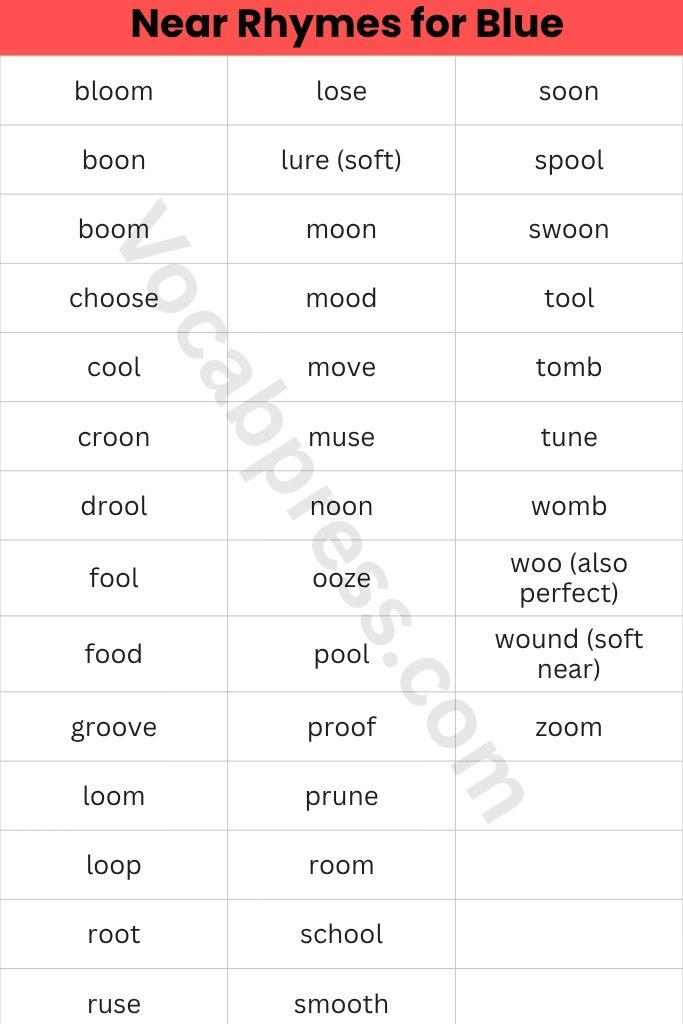
Near rhymes share a similar vowel sound but are not exact matches. They work naturally in rap, modern poetry, and casual captions.
- bloom
- boon
- boom
- choose
- cool
- croon
- drool
- fool
- food
- groove
- loom
- loop
- lose
- lure (soft)
- moon
- mood
- move
- muse
- noon
- ooze
- pool
- proof
- prune
- room
- root
- ruse
- school
- smooth
- soon
- spool
- swoon
- tool
- tomb
- tune
- womb
- woo (also perfect)
- wound (soft near)
- zoom
Slant Words That Rhyme With Blue
Slant rhymes share only part of the sound — usually the vowel or just the consonant. Poets use these to avoid sounding too sing-song.
- claw (vowel shift)
- flow
- glow
- go
- grow
- know
- low
- owe
- show
- slow
- snow
- sow
- throw
- tow
- whoa
- woe
- blow (present tense, not past)
Rhymes for Blue by Word Length
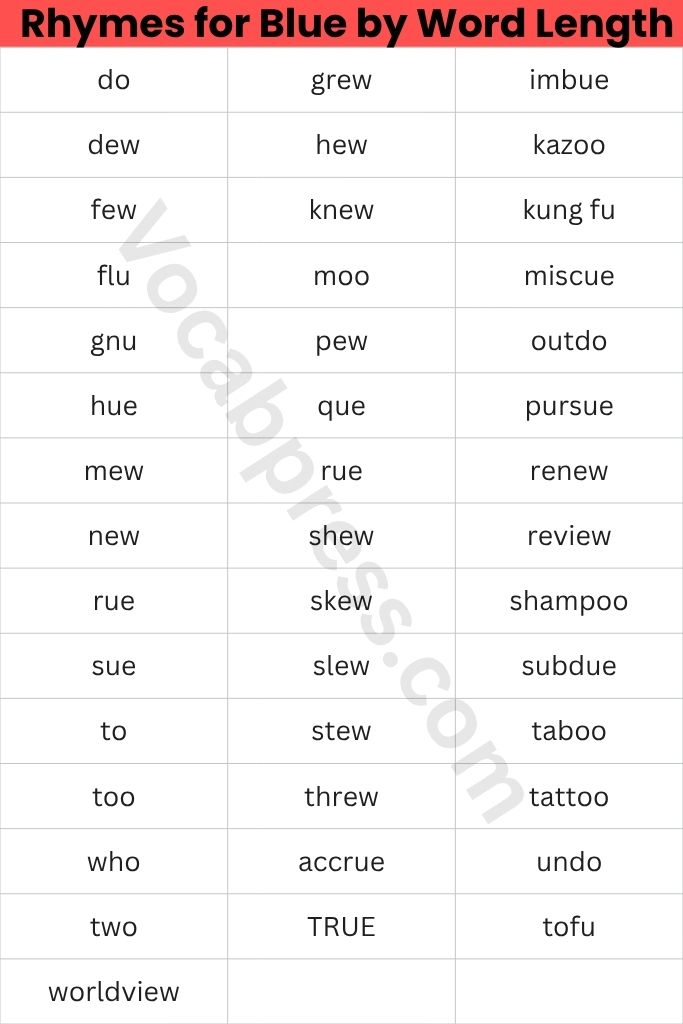
Short Words (2–4 letters)
- do
- dew
- few
- flu
- gnu
- hue
- mew
- new
- rue
- sue
- to
- too
- two
- who
- woo
- yew
- you
- zoo
- blew
- brew
- chew
- clue
- coo
- cue
- flew
- glue
- goo
- grew
- hew
- knew
- moo
- pew
- que
- rue
- shew
- skew
- slew
- stew
- threw
- true
Rhymes for Blue Medium Words (5–8 letters)
- accrue
- anew
- askew
- bamboo
- bestow
- bijou
- canoe
- cashew
- construe
- cuckoo
- debut
- ensue
- eschew
- fondue
- hairdo
- haiku
- imbue
- kazoo
- kung fu
- miscue
- outdo
- pursue
- renew
- review
- shampoo
- subdue
- taboo
- tattoo
- tofu
- undo
- voodoo
- wahoo
- yahoo
Long Words Rhymes for Blue (9+ letters)
- avenue
- barbecue
- boogaloo
- cockatoo
- continue
- didgeridoo
- follow-through
- hullabaloo
- ingenue
- interview
- kinkajou
- marabou
- misconstrue
- overdue
- parvenu
- residue
- retinue
- revenue
- rendezvous
- switcheroo
- worldview
Spelling Patterns That Make the /uː/ Sound
The same sound appears in many different letter combinations. Understanding this helps with phonics and spelling.
-ue words:
- blue
- clue
- due
- glue
- hue
- rue
- sue
- true
- cue
-ew words:
- dew
- drew
- flew
- few
- grew
- knew
- new
- threw
-oo words:
- bamboo
- boo
- cuckoo
- goo
- kazoo
- moo
- shampoo
- tattoo
- voodoo
- zoo
-ou words:
- through
- you
-o words:
- do
- to
- who
-eau words:
- bureau
- plateau (near)
- trousseau (near)
-u words:
- flu
- gnu
- tofu
Rhymes for Blue Homophones — Same Sound, Different Word
| Rhyming Word | Its Homophone | Meaning Difference |
| blue | blew | color vs. past tense of blow |
| dew | do, due | water droplets vs. action/debt |
| flew | flu | past tense of fly vs. illness |
| knew | new, gnu | past tense of know vs. something recent vs. animal |
| two | to, too | number vs. direction vs. also |
| hue | Hugh | color shade vs. a person’s name |
| sue | Sioux | take to court vs. Indigenous people |
| yew | you, ewe | tree vs. person vs. female sheep |
| cue | queue | signal vs. a line of people |
| pew | pooh | church bench vs. an expression |
Rhymes for Blue Words With Meanings
Understanding a word makes it easier to use naturally:
- Clue — a hint or piece of evidence that helps solve something
- Dew — tiny water drops that settle on surfaces overnight
- Hue — a specific shade or tone of a color
- Rue — to deeply regret something
- Brew — to make something slowly, like tea or trouble
- Ensue — to happen as a result of something
- Imbue — to fill something with a strong quality or feeling
- Construe — to interpret or understand something in a certain way
- Misconstrue — to understand something incorrectly
- Residue — what is left behind after something is removed
- Taboo — something that society considers off-limits or forbidden
- Parvenu — someone who has recently gained wealth or importance
- Ingenue — an innocent or naive young woman, often in theater
- Retinue — a group of people who travel with an important person
- Kinkajou — a small rainforest mammal, also called a honey bear
- Marabou — a large stork, or fluffy feather trim on clothing
- Didgeridoo — a long wind instrument played by Indigenous Australians
- Switcheroo — a sudden or surprising swap or change
- Rendezvous — a planned meeting, often in a specific place
- Revue — a type of theatrical show with songs and sketches
- Eschew — to deliberately avoid something
- Subdue — to bring something under control
- Accrue — to collect or build up over time
- Askew — tilted or not quite straight
- Bijou — something small and elegant
- Ingenue — a naive, innocent young character
Read also – Words That Rhyme With Time: Easy Rhymes for Poems, Songs, Kids & Rap
Rhymes for Blue Example Sentences
- She had not one clue where the afternoon had gone.
- Grass covered in morning dew looked like scattered glass.
- He stayed true even when it was the harder thing to do.
- The old wall showed every hue of the original blue paint.
- She chose to pursue what felt right, not what looked easy.
- The crew arrived late, and tension started to brew.
- He withdrew quietly before things had a chance to escalate.
- The barbecue smoke drifted across the whole neighborhood.
- Her words were easy to misconstrue without the right context.
- The residue left on the glass took three washes to remove.
- The switcheroo caught everyone completely off guard.
- They planned a rendezvous at the old café by the harbor.
- The retinue followed closely behind wherever she went.
- His advice was hard to construe without more background.
- Years of savings began to accrue quietly in the background.
Useful Rhyming Phrases
These are real phrase pairings writers actually use — not random word dumps:
- out of the blue / right on cue
- something new / something true
- tried and true / through and through
- morning dew / fresh and new
- a different hue / a different view
- the whole crew / what they knew
- nothing to lose / nothing to prove (near rhyme)
- overdue / long withdrew
- pursue the truth / nothing to lose (near)
- in full view / as we grew
Short Rhyming for Blue Lines
Good for hooks, opening lines, or quick inspiration:
- The sky was blue, the grass had dew.
- She grew and flew and nobody knew.
- He chased the view his whole life through.
- Something new came out of the blue.
- The rose had every hue but blue.
- They stayed true, the whole crew through.
- What once he knew, the wind just blew.
- A different hue, a different you.
- The morning dew was something new.
- She saw right through to something true.
Funny Words That Rhyme With Blue
- My dog ate my shoe and turned it blue.
- I made a stew that tasted like glue.
- At the zoo, a kangaroo sneezed on my shoe.
- He got a tattoo of a cashew — quite a debut.
- The cockatoo played the didgeridoo for the crew.
- She brewed a stew that nobody knew how to chew.
- My hairdo flew away — I have not a clue where to.
Mini Poems
For kids:
The sky is blue,
The grass has dew,
I learned something new,
And so did you.
Nature:
Morning dew on every leaf,
The heron flew above the reef,
The world was painted every hue,
Soft gold and green and endless blue.
Friendship:
We went through the hard times, me and you,
Stayed true when skies turned any hue,
You always knew what I was going through,
That kind of friendship was long overdue.
Motivational:
Start something new before you are through,
Pursue the dream that lives in you,
Every hue of life came into view,
And somehow, quietly, you grew.
Funny:
I glued my shoe to something blue,
I have no clue, I really do not,
The bamboo straw I used for stew,
Is now a mess — and so am I too.
Rhymes for Blue for Songs
For songs, smooth-sounding rhymes matter more than unusual ones.
Best picks for song hooks:
- true
- you
- knew
- through
- new
- view
- grew
- flew
Tips:
- Pair “blue” with “true” or “you” for emotional resonance — listeners feel it.
- Use “through” when the song carries a sense of struggle or journey.
- Use “new” for hopeful or uplifting choruses.
- Avoid “gnu,” “shrew,” or “mew” unless the song is deliberately comic.
- Two-syllable options like “pursue,” “renew,” and “withdrew” give more melodic flexibility.
Rhymes for Rap
Rap rewards multi-syllable rhymes, internal rhymes, and stacked sounds.
Single rhyme starters:
- blue / clue / true / you / crew / knew / do / through / who / two
Multi-syllable stacks:
- blue skies / new rise / true lies / flew by
- out of the blue / nothing I knew / stuck like glue / had to push through
- pursue the truth / remove the proof / nothing to lose / nothing to prove
- the whole crew knew / what we been through / overdue / construe
Internal rhyme ideas:
- “Feeling overdue, running from the blue”
- “The whole crew knew what we been through”
- “No clue what to do, still staying true”
- “Misconstrue the view, misconstrue what’s true”
Flow tips:
- Stack two-syllable rhymes for speed and energy.
- Drop to single syllables when you want emotional weight.
- Mix “knew / true / through / do” for AABB or ABAB patterns.
- Use “withdrew,” “ensue,” and “construe” for a more literary rap style.
Blue Rhymes for Captions
Romantic:
- Out of the blue, there was you.
- Every hue looked brighter with you in view.
- Stayed true — that is all we ever knew.
Funny:
- No clue, but make it blue.
- Showed up at the zoo with one shoe. Classic.
- Life gave us barbecue and a kangaroo. We accepted.
Aesthetic / calm:
- Morning dew. Something new.
- Soft hue. Still true.
- Flew through. Grew into you.
Motivational:
- Pursued what I knew. Grew into the view.
- Overdue? No — right on cue.
Words That Rhyme With Blue Kids Section
Easy rhymes for young readers — common words, short, simple:
- blue
- clue
- dew
- flew
- glue
- grew
- knew
- new
- shoe
- stew
- true
- two
- you
- zoo
Simple sentences for reading practice:
- The sky is blue.
- I have a clue.
- My shoe is new.
- We went to the zoo.
- The bird flew.
- The flower grew.
- The glue is stuck.
- We made a stew.
Phonics Section
The /uː/ sound hides in many spelling patterns. This is one of the best phonics teaching opportunities in English.
Key patterns to teach:
- -ue → blue, clue, glue, true, hue, due
- -ew → new, dew, flew, grew, knew, threw
- -oo → zoo, bamboo, shampoo, tattoo, voodoo
- -o → do, to, who
- -ou → you, through
- -u → flu, gnu, tofu
Pronunciation note: All of these make the same long “oo” sound. The mouth rounds gently and the sound comes from the back of the mouth. Same sound as in “moon,” “food,” “pool,” and “blue.”
Phonics activity: Give students 20 word cards. They sort them into columns by spelling pattern. No memorizing — just pattern spotting.
Classroom Activities
Matching game:
Write rhyming word pairs on separate cards. Students flip them face down and find matches.
Sorting activity:
Give students a list of 20 words. They sort by spelling pattern: -ue, -ew, -oo, -o, -ou.
Fill in the blank:
- The sky was ____, and the grass had ____. (blue / dew)
- She stayed ____, through and ____. (true / through)
- He had no ____ what the ____ would do. (clue / crew)
Rhyme writing challenge:
Give students the word “blue” and ask for a four-line verse where every other line rhymes.
Phonics worksheet:
Show pictures of a shoe, zoo, dew, and glue. Students write the word and circle the part that makes the /uː/ sound.
Writing Uses of Words That Rhyme With Blue
Poetry: Use “hue,” “dew,” and “view” for visual imagery. These paint pictures without being too obvious.
Storytelling: “Through,” “knew,” and “grew” carry emotional and narrative weight. They work for a character’s inner journey.
Song lyrics: “True,” “you,” and “new” are the most emotionally connecting. Audiences feel these words.
Speeches: “True,” “pursue,” and “renew” feel strong and dignified in closing lines.
Creative writing: “Overdue,” “taboo,” and “withdrew” add complexity and texture without sounding forced.
Rap: “Misconstrue,” “ensue,” “construe,” and “accrue” give a more intellectual and original flow.
Positive Rhymes for Blue
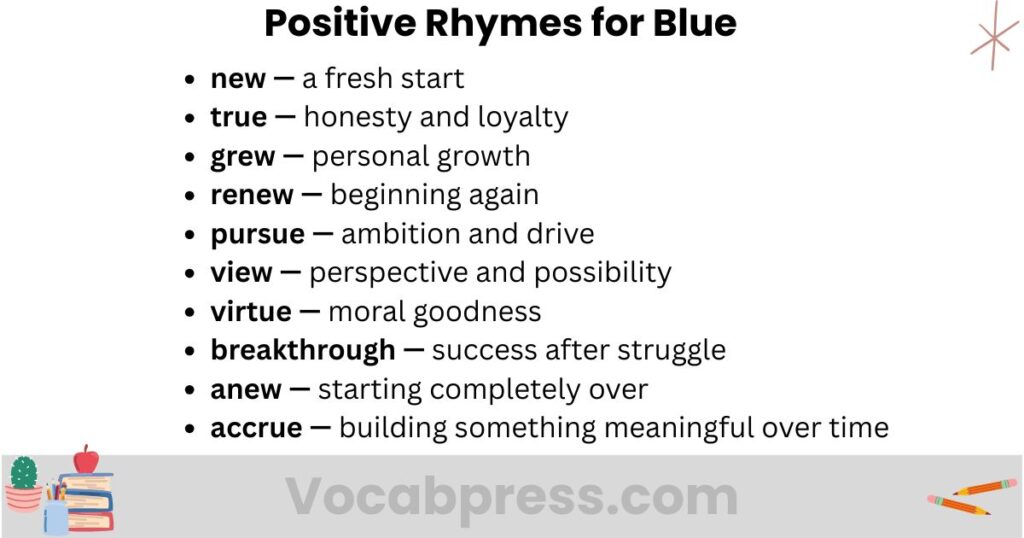
These carry hopeful, uplifting energy:
- new — a fresh start
- true — honesty and loyalty
- grew — personal growth
- renew — beginning again
- pursue — ambition and drive
- view — perspective and possibility
- virtue — moral goodness
- breakthrough — success after struggle
- anew — starting completely over
- accrue — building something meaningful over time
Negative or Darker Rhymes for Blue
These carry heavier emotional weight — useful for honest, emotional writing:
- rue — deep regret
- withdrew — pulling back or disappearing
- overdue — something neglected too long
- taboo — something forbidden or shameful
- misconstrue — a painful misunderstanding
- miscue — a mistake at the wrong moment
- construe — often used when something was taken the wrong way
- subdue — suppressing something or someone
- eschew — deliberately turning away
Emotional Rhymes for Blue
Love and romance:
- you
- true
- knew
- through
- pursue
- adieu
- rendezvous
- imbue
Sadness and loss:
- rue
- withdrew
- blew
- flew
- overdue
- adieu
Friendship:
- crew
- grew
- knew
- through
- true
Heartbreak:
- withdrew
- misconstrue
- blew
- knew
- overdue
- adieu
Inspiration:
- new
- pursue
- renew
- view
- virtue
- breakthrough
- accrue
- anew
Best Rhymes for Blue by Category
| Category | Best Words |
| Kids poems | shoe, zoo, new, glue, dew, flew, clue, stew |
| Romantic poems | true, you, knew, through, pursue, adieu, rendezvous |
| Rap lyrics | crew, through, construe, pursue, withdrew, overdue, misconstrue |
| Song hooks | you, true, new, view, grew, through, flew |
| Instagram captions | clue, hue, new, you, view, out of the blue |
| Classroom worksheets | blue, clue, glue, new, dew, shoe, zoo, stew |
| Storytelling | grew, knew, withdrew, through, overdue, ensue |
| Motivational writing | renew, pursue, virtue, breakthrough, new, accrue, anew |
| Funny writing | kangaroo, switcheroo, hullabaloo, boogaloo, didgeridoo |
| Advanced poetry | imbue, parvenu, ingenue, construe, retinue |
Read more – Words That Rhyme With Go: Complete List, Examples and Rhyming Guide
Common Mistakes
Mixing up homophones in writing: “Blew” and “blue” sound identical but carry completely different meanings. Writing one when you mean the other changes the whole sentence.
Overusing “you” and “true”: These are the easiest rhymes, so many writers reach for them every single time. After a while, they feel like a shortcut rather than a choice.
Treating near rhymes as perfect rhymes: Words like “moon,” “room,” and “soon” are near rhymes. They work in context but are not exact matches for “blue.”
Forcing rare words just to rhyme: Using “gnu” or “shrew” only because they technically rhyme draws the reader away from the message and into confusion.
Ignoring multi-syllable options: Single-syllable rhymes are easy to find. But “pursue,” “taboo,” “renew,” “overdue,” and “misconstrue” open up better line structures and more interesting writing.
Rhyming words that do not actually rhyme: Some writers try to rhyme “blue” with “love” or “move.” These are not rhymes — they are similar vibes, not matching sounds.
Words to Avoid (Unless You Have a Clear Reason)
- Gnu — almost no one knows this word outside of crosswords or wildlife documentaries
- Shrew — sounds forced in most writing and brings a very specific, unpleasant image
- Mew — rare, easily confusing, and mostly used in falconry
- Pew — works technically, but carries an immediate church image that may not fit
- Slew — means “killed a large number of,” which often surprises readers who expect something gentler
- Phew — works in very casual writing only; sounds awkward in poetry or songs
Summary
The word “blue” connects to one of the widest rhyme families in English. Perfect rhymes like “true,” “knew,” and “grew” carry emotional weight across poetry, songs, and storytelling. Near rhymes like “moon” and “room” give writers flexibility when a perfect rhyme would feel too obvious. Multi-syllable options like “overdue,” “pursue,” “misconstrue,” and “hullabaloo” open up better line structures for rap, creative writing, and advanced poetry.
Whether you need something simple for a kids worksheet or something layered for a rap verse, this list of words that rhyme with blue has what you need. Pick the word that fits the feeling of the line first — not just the easiest one you can grab.

It’s Afini, I am the author at Vocab press, a website focused on animal facts with clear visuals and simple guides. I research and share accurate, easy-to-understand information for readers of all ages. My goal is to make learning about animals fun, trustworthy, and simple. I follow fact-based writing and keep content updated, helpful, and people-first. Thank you for reading.