Finding the right Words That Rhyme With Heart can make a poem, song, caption, or classroom activity feel more natural. Some rhymes are exact, while others create a softer sound that still works well. This guide brings them together in one simple place, with clear examples to help you pick the best word for any piece of writing.
Quick Answer: Top Rhymes at a Glance
Perfect rhymes for “heart” follow the -art ending sound. Here are the most useful ones right away:
- art
- part
- start
- chart
- smart
- dart
- cart
- tart
- mart
- apart
- depart
- impart
- upstart
- outsmart
- rampart
- sweetheart
- counterpart
- flowchart
- oxcart
- Bonaparte
Five quick example sentences:
- She turned every scar into beautiful art.
- The hardest step is always the start.
- Two people can love each other and still live worlds apart.
- He was too smart to fall for the same trick twice.
- That lemon filling was wonderfully tart.
Perfect Words That Rhyme With Heart: Full List
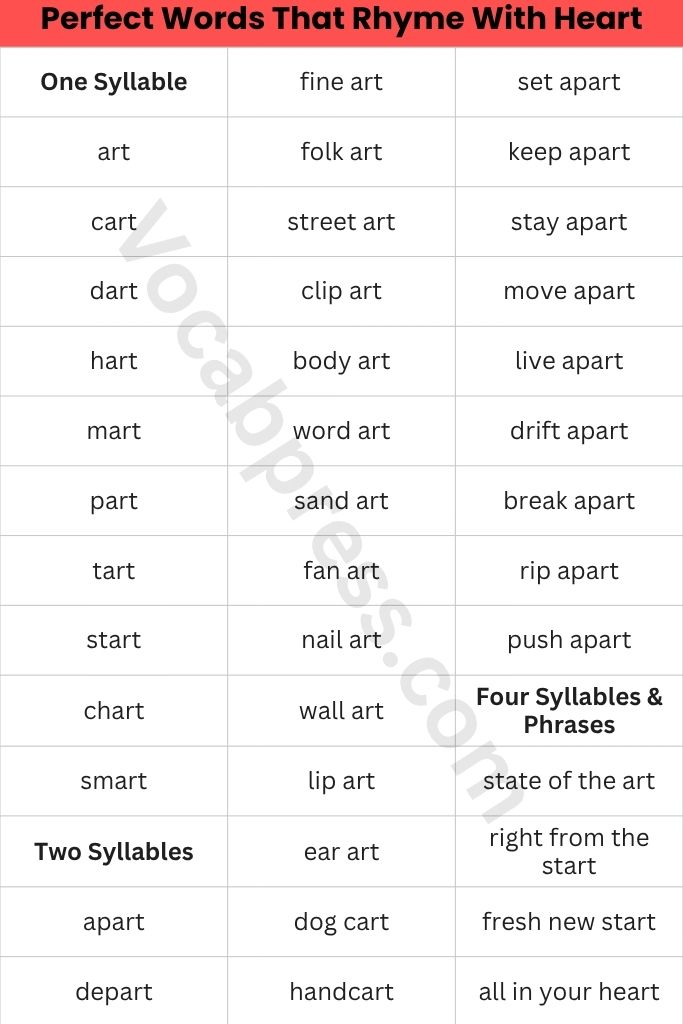
These all share the exact -art ending sound as “heart.”
One Syllable Rhyme With Heart
- art
- cart
- dart
- hart
- mart
- part
- tart
- start
- chart
- smart
Two Syllables Rhyme With Heart
- apart
- depart
- impart
- upstart
- outsmart
- rampart
- sweetheart
- go-cart
- oxcart
- pushcart
- flowchart
- restart
- jumpstart
- pop art
- op art
- fine art
- folk art
- street art
- clip art
- body art
- word art
- sand art
- fan art
- nail art
- wall art
- lip art
- ear art (creative/rap)
- dog cart
- handcart
- dust cart
- dung cart
- bullock cart
- tram cart
Three Syllables Rhyme With Heart
- counterpart
- work of art
- Bonaparte
- à la carte
- martial art
- fall apart
- take apart
- tear apart
- pull apart
- grow apart
- come apart
- set apart
- keep apart
- stay apart
- move apart
- live apart
- drift apart
- break apart
- rip apart
- push apart
Four Syllables and Phrases Rhyme With Heart
- state of the art
- right from the start
- fresh new start
- all in your heart
- play a big part
- speak from the heart
- bless your heart
- change of heart
- bottom of the heart
- follow your heart
- open your heart
- mend a broken heart
- know it by heart
- wear your heart
- close to the heart
- straight from the heart
- matter of the heart
- affairs of the heart
- break someone apart
- rip someone apart
- art for art’s sake
- à la carte menu
- martial arts style
- a brand new start
Near Words That Rhyme With Heart
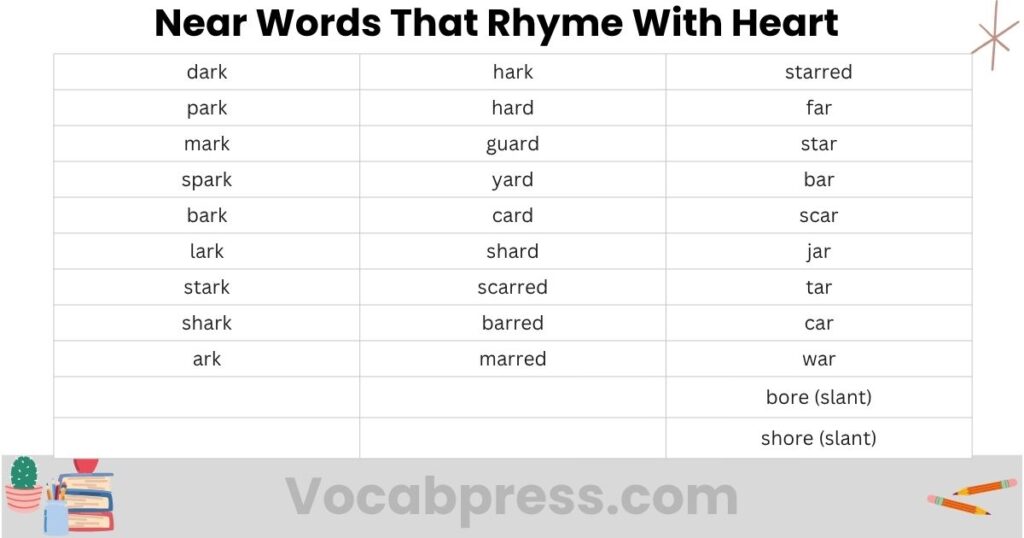
Near rhymes share a similar but not identical sound. Songwriters and rappers use these constantly — they feel right in context even though they are not a technical match.
Why they work: The ear follows rhythm. When the beat or melody is strong, a near rhyme lands as convincingly as a perfect one.
Near rhyme list for heart:
- dark
- park
- mark
- spark
- bark
- lark
- stark
- shark
- ark
- hark
- hard
- guard
- yard
- card
- shard
- scarred
- barred
- marred
- starred
- far
- star
- bar
- scar
- jar
- tar
- car
- war
- bore (slant)
- shore (slant)
Example using near rhymes: “She left a scar / deeper than the dark / I lost my heart / somewhere in that park.”
All four lines feel connected without being identical — that is the craft of near rhyming.
Slant Words That Rhyme With Heart
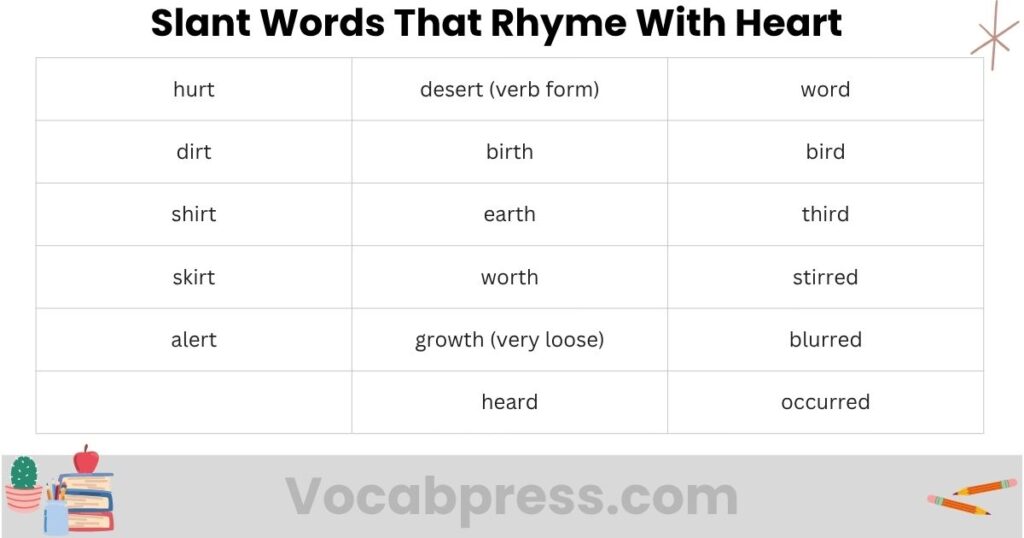
Slant rhymes share some sounds but are even looser. They work best in emotional, literary, or experimental poetry where mood matters more than precision.
Slant rhymes for heart:
- hurt
- dirt
- shirt
- skirt
- alert
- desert (verb form)
- birth
- earth
- worth
- growth (very loose)
- heard
- word
- bird
- third
- stirred
- blurred
- occurred
Example in a poem: “She found her worth / long before her birth / into a world of hurt / covered in old dirt.”
Not clean rhymes — but they hit harder emotionally than anything polished.
Rhymes with Heart by Syllable Count
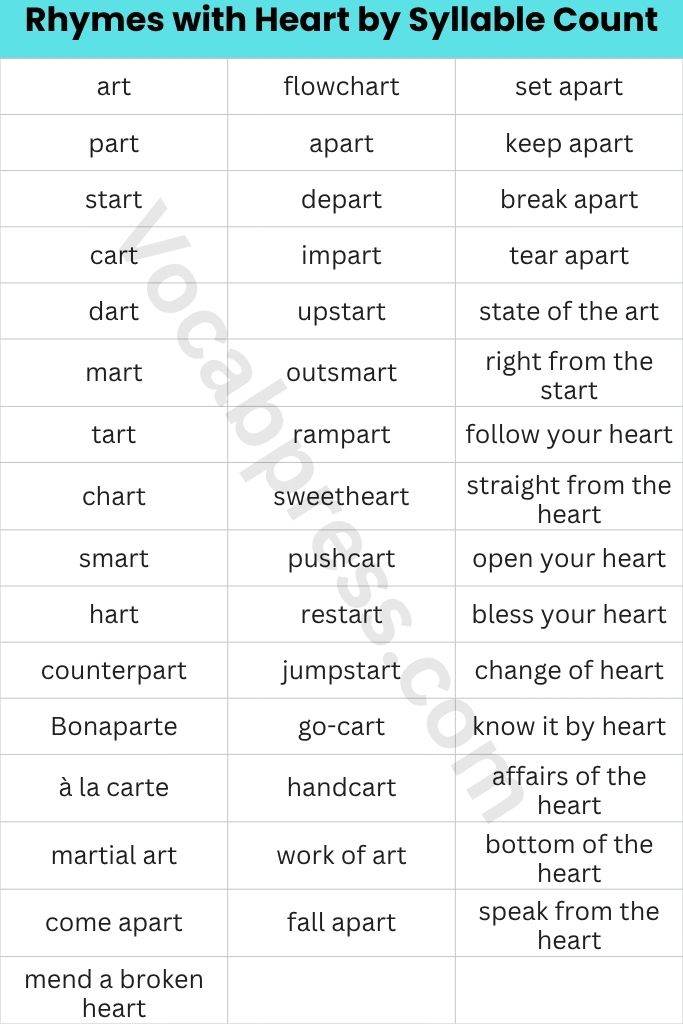
One Syllable — Simple and Direct
- art
- part
- start
- cart
- dart
- mart
- tart
- chart
- smart
- hart
Two Syllables — Emotional Middle Ground
- apart
- depart
- impart
- upstart
- outsmart
- rampart
- sweetheart
- pushcart
- restart
- jumpstart
- go-cart
- handcart
- flowchart
Three Syllables — Rich and Expressive
- counterpart
- Bonaparte
- à la carte
- martial art
- work of art
- come apart
- fall apart
- set apart
- keep apart
- break apart
- tear apart
Four Syllables and Longer — Great for Rap and Song Hooks
- state of the art
- right from the start
- follow your heart
- straight from the heart
- open your heart
- bless your heart
- change of heart
- know it by heart
- affairs of the heart
- bottom of the heart
- speak from the heart
- mend a broken heart
Rhyme With Heart by Word Length
Short Words (3–5 letters)
- art
- cart
- dart
- hart
- mart
- part
- tart
- start
- chart
- smart
Medium Words (6–9 letters)
- apart
- depart
- impart
- upstart
- outsmart
- rampart
- sweetheart
- go-cart
- handcart
- flowchart
- pushcart
- jumpstart
- oxcart
- restart
Longer Words and Phrases (10+ letters)
- counterpart
- Bonaparte
- à la carte
- martial arts
- state of the art
- work of art
- follow your heart
- change of heart
- speak from the heart
- right from the start
- affairs of the heart
- know it by heart
Spelling Patterns and Pronunciation
“Heart” is spelled H-E-A-R-T but pronounced like “hart.” The “ea” makes a short “ah” sound here — not the long “ee” sound you see in words like “heat” or “bean.”
The standard -art spelling pattern:
Most perfect rhymes follow this build: one or more consonants + art
- d + art = dart
- p + art = part
- st + art = start
- ch + art = chart
- sm + art = smart
- imp + art = impart
- dep + art = depart
- count + erpart = counterpart
“Heart” breaks the pattern — it uses “ea” instead of “a” but lands on the exact same sound. This is one of the most common English spelling exceptions and a great teaching moment for phonics.
Pronunciation tip: Say “heart” and hold the middle “ah” sound. Every word that ends on that same “ahrt” shape is a perfect rhyme, no matter how it is spelled.
Rhyme With Heart Homophones
“Heart” has one near-homophone worth knowing:
Hart — an old English word for a fully grown male deer, especially one over five years old. It is pronounced exactly like “heart.”
- The hart leaped across the frozen stream at dawn.
This creates natural double meaning in poetry. A line about a “hart” running free can also be read as a heart breaking loose — that kind of layered meaning is what separates good poetry from great poetry.
No other true homophones exist for “heart.”
Rhyme With Heart Words With Meanings
- art — creative work including painting, music, writing, and design
- part — a section of something, or a role someone plays
- start — the beginning of something
- chart — a visual diagram or graph; also to map a course
- dart — to move suddenly and fast; also a small pointed throwing object
- tart — sharp or sour in taste; also a small open pastry
- mart — a market or store
- hart — a male deer over five years old
- impart — to share or give knowledge to someone else
- depart — to leave a place or situation
- rampart — a wide defensive wall built around a castle or fort
- sweetheart — a term of love; someone you care for deeply
- upstart — someone who rises to success quickly, often seen as arrogant
- outsmart — to be cleverer than someone in a situation
- counterpart — a person or thing that holds the same role as another
- jumpstart — to give something a boost to get it going
- à la carte — choosing individual items from a menu rather than a set meal
- Bonaparte — family name of Napoleon; used in rap for creative rhyming
- martial art — a system of combat training such as karate or judo
- flowchart — a diagram showing steps in a process
Words That Rhyme With Heart Example Sentences
Each sentence is unique and shows the word in a real, natural context:
- The gallery displayed her art across three floors.
- He played the difficult part without a single complaint.
- Every great journey needs a start, no matter how small.
- The doctor pointed to the chart to explain the results.
- The rabbit gave a quick dart behind the bushes.
- The rhubarb filling was wonderfully tart.
- They lived apart for two years before finally moving in together.
- She chose to depart before the argument could get worse.
- He managed to outsmart every opponent at the table.
- The professor tried to impart something useful in every lecture.
- The old castle rampart had stood for six hundred years.
- My grandmother called everyone sweetheart, and meant it every time.
- Nobody expected the upstart company to beat the industry giant.
- She was the perfect counterpart to his chaotic energy.
- The engine needed a jumpstart on the cold morning.
- They ordered à la carte and spent three hours at the table.
Rhyme With Heart Phrases
Phrases that rhyme with “heart” — useful for titles, song hooks, speech lines, and captions:
- fresh start
- fall apart
- work of art
- right from the start
- play your part
- world apart
- smart from the start
- state of the art
- bless your heart
- speak from the heart
- torn apart
- change of heart
- follow your heart
- know it by heart
- straight from the heart
- break apart
- brand new start
- born with heart
Short Rhyme With Heart Lines
Ready-made lines for poems and songs:
- She fell apart, then found her heart.
- He called it art; she called it a start.
- Worlds apart, still close at heart.
- Smart enough to know when to depart.
- The hardest part was watching you depart.
- She played the part but came apart.
- Built a work of art from a broken heart.
- From the very start, she knew it by heart.
Funny Rhyme With Heart
- “My dog thinks he is a work of art, riding shotgun in my cart from the very start — honestly, he owns my whole dumb heart.”
- “I tried to be smart, ordered a fancy tart, ate the whole cart, now I need a fresh start.”
- “She stole my heart, and somehow my shopping cart. That takes a special kind of art.”
Funny rhymes land best when the unexpected word arrives at the very end of the last line. The surprise is the punchline.
Mini Poems
Love:
She never needed much, right from the start.
She turned a quiet life into lasting art.
No grand performance, no practiced part —
just someone real, who spoke from the heart.
Friendship:
You stayed when everything fell apart.
You never needed a chart or a plan.
You just showed up and played your part —
the truest, most reliable kind of heart.
Nature:
The hart runs fast at morning’s start,
through fields that look like living art.
The world wakes slow, each quiet part,
and something moves inside my heart.
Motivational:
You are not just playing a small part.
The hardest roads still have a start.
What you are building is a work of art.
Let everything you do come from the heart.
Funny (Kids):
My little dog is very smart.
He rides around inside my cart.
He eats my tart right from the start.
I think he owns my whole entire heart.
Rhyme With Heart for Songs
Not every rhyme sounds good when sung. Some sit perfectly in a melody; others feel forced the moment you open your mouth.
Best for slow songs and ballads:
- apart — open vowel, holds well on long notes
- sweetheart — warm, easy to sing softly
- fall apart — emotional peak, works in a chorus
- start — clean and hopeful, lands well at the end of a bridge
Best for upbeat or pop songs:
- smart — punchy and confident
- jumpstart — energetic, good for pre-chorus
- restart — comeback theme, pairs naturally with “heart”
- right from the start — great opening line for any verse
Songwriting tip: Pair “heart” in the verse and “apart” or “start” in the chorus. That shift creates emotional movement — which is exactly what a good song needs.
Rhyme With Heart for Rap
Rap rewards density. Simple end rhymes work, but internal rhymes and multi-syllable stacks make verses stand out.
Strong single rhymes for rap:
- outsmart
- counterpart
- Bonaparte
- state of the art
- fall apart
Internal rhyme example: “I played my part, smart from the very start, built a work of art while the world fell apart.”
That line uses part, smart, start, art, and apart — five rhyme sounds spread across a single bar. That density signals skill.
Multi-syllable rhyme stack:
“I’m the counterpart to every broken heart, the outsmart to every fall apart, Bonaparte with a brand new start.”
Rap tip: Do not save the rhyme only for the last word. Spread rhyme sounds across the whole line. That is what separates a verse that sounds skilled from one that just technically rhymes.
Rhyme With Heart for Captions
Romantic:
- “You are my favorite work of art.”
- “Right from the start, straight to my heart.”
- “Worlds apart, but close at heart.”
Funny:
- “Fell apart. Had a fresh start. Bought snacks. Better now.”
- “Smart enough to eat the whole tart. Zero regrets.”
Motivational / Aesthetic:
- “Every ending is just a start.”
- “She rebuilt herself and called it art.”
- “Not perfect. Just real. Straight from the heart.”
Short Form (TikTok / Reels):
- “Plot twist: the hard part was just the start.”
- “Fall apart. Restart. Repeat.”
- “From the heart. That is the only way I know.”
Kids Words That Rhyme With Heart
These are the easiest rhymes for young learners:
- art — drawing and painting
- cart — a small wagon with wheels
- dart — throwing something fast in a straight line
- part — a piece of a bigger thing
- start — to begin something
- tart — sour or sharp taste, like lemon
- smart — clever and quick thinking
- chart — a picture that shows information
- go-cart — a small, low vehicle kids drive for fun
Simple reading sentences:
- I made some art for you.
- The dog sat in the cart.
- Let us start the game now.
- She is very smart in class.
- That orange tastes a bit tart.
Reading practice rhyme:
Art and cart and dart and part — all of these words rhyme with heart.
Phonics
Understanding spelling patterns helps early readers decode new words faster.
The -art word family:
- art
- cart
- dart
- mart
- part
- tart
- start
- chart
- smart
Pattern rule: consonant(s) + art
- d + art = dart
- p + art = part
- st + art = start
- ch + art = chart
- sm + art = smart
“Heart” is the exception. It uses “ea” in the middle but sounds exactly like the -art family. Teaching this exception builds stronger reading skills than just memorizing rules.
Pronunciation exercise: Say each word slowly and clearly: art… cart… dart… heart. Notice your mouth lands in exactly the same position at the end of every word. That shared ending movement is what creates the rhyme.
Classroom Activities
Word Sort
Give students a mixed word list. They sort into three columns: perfect rhyme, near rhyme, does not rhyme.
Fill in the Blank
Write poem lines with the final word missing. Students choose from a rhyme bank.
“She had a kind and giving ___.” (heart / art / part)
Memory Card Match
Make pairs of rhyming cards. Students flip and match face-down — same format as the classic memory game.
Build-a-Poem
Students pick any three rhyming words and write a four-line poem using all three. No minimum length — just genuine effort.
Rhyme Hunt
Read a short picture book or song aloud. Students underline or tap every word that rhymes with “heart.”
Spelling Pattern Worksheet
List the -art word family. Students write each word, draw a quick picture beside it, and use it in one original sentence.
Rhyme With Heart Writing Uses
Rhyme does more than sound good — it shapes how a reader or listener feels.
In poems: Rhyme creates rhythm, and rhythm makes lines memorable. A rhymed line stays in the mind long after the poem ends.
In songs: Rhyme signals where a phrase is going. It builds expectation and then delivers — which is why a strong chorus feels like emotional release.
In rap: Dense rhyme schemes signal technical skill. The more rhyme sounds layered into a verse, the more impressive and deliberate the writing sounds.
In speeches: A well-placed rhyme makes a point stick. “From the heart, not just the chart” lands harder than any plain sentence.
In children’s books: Rhyming lines help young readers track meaning and stay engaged. They also make books easier to read aloud.
In creative writing: Slant rhymes and near rhymes build texture without making writing feel like a nursery rhyme. They create mood with subtlety.
Positive Words That Rhyme With Heart
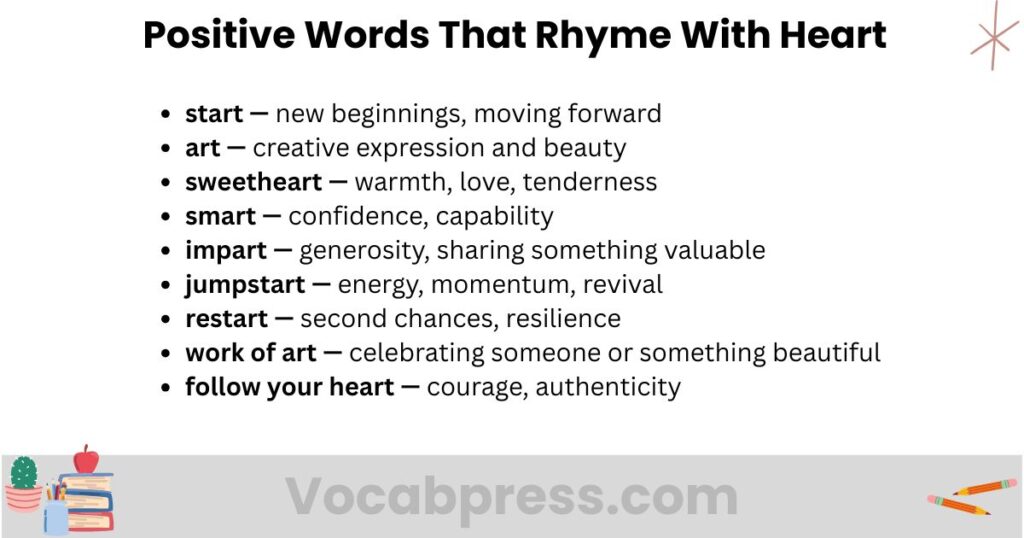
Words that carry hopeful, uplifting energy when paired with “heart”:
- start — new beginnings, moving forward
- art — creative expression and beauty
- sweetheart — warmth, love, tenderness
- smart — confidence, capability
- impart — generosity, sharing something valuable
- jumpstart — energy, momentum, revival
- restart — second chances, resilience
- work of art — celebrating someone or something beautiful
- follow your heart — courage, authenticity
Negative or Heavy Rhyme With Heart
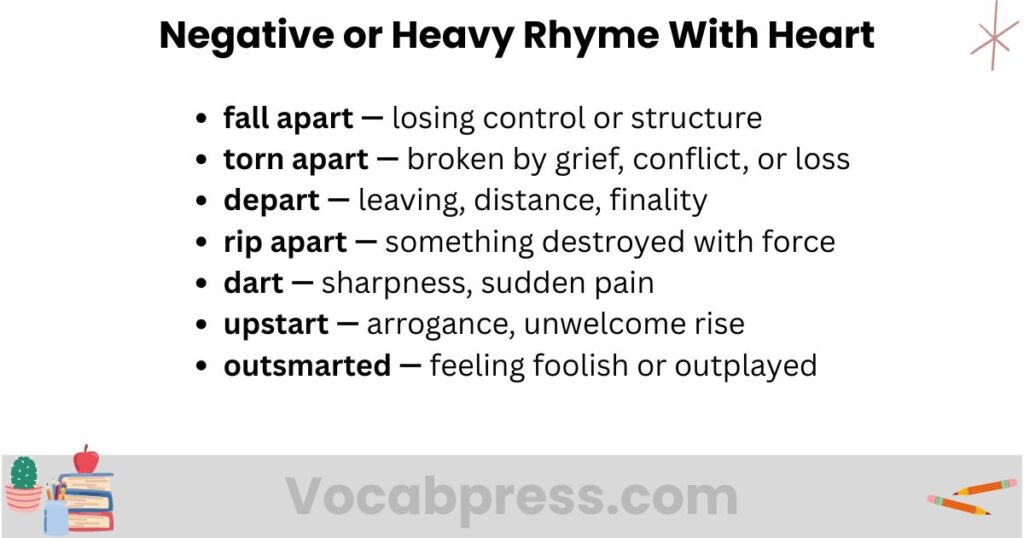
These carry emotional weight — useful in breakup writing, dramatic poetry, or conflict:
- fall apart — losing control or structure
- torn apart — broken by grief, conflict, or loss
- depart — leaving, distance, finality
- rip apart — something destroyed with force
- dart — sharpness, sudden pain
- upstart — arrogance, unwelcome rise
- outsmarted — feeling foolish or outplayed
These are not negative to avoid — they are powerful to use intentionally. Contrast them with positive rhymes to create emotional movement in a piece.
Emotional Rhyming Words by Feeling
Love and romance:
- sweetheart
- impart
- start
- from the heart
- open your heart
- follow your heart
Grief and loss:
- fall apart
- torn apart
- depart
- rip apart
- worlds apart
- come apart
Friendship:
- part
- counterpart
- play your part
- bless your heart
Motivation and resilience:
- start
- restart
- jumpstart
- outsmart
- work of art
- right from the start
- state of the art
Longing and distance:
- apart
- worlds apart
- depart
- keep apart
- drift apart
- stay apart
- live apart
Best Rhyme With Heart by Category
Kids and Beginners:
- art, cart, dart, mart, part, tart, smart, start, chart, go-cart
Love Poems and Romantic Writing:
- sweetheart, apart, start, fall apart, follow your heart, from the heart, open your heart
Breakup and Emotional Writing:
- fall apart, torn apart, depart, worlds apart, drift apart, rip apart
Songs and Ballads:
- apart, sweetheart, fall apart, start, restart, right from the start
Rap Verses:
- counterpart, outsmart, Bonaparte, state of the art, work of art, fall apart
Motivational Writing:
- start, restart, jumpstart, outsmart, work of art, right from the start, follow your heart
Captions:
- work of art, fresh start, from the heart, fall apart, worlds apart
Classroom and Phonics:
- art, cart, dart, mart, part, tart, smart, start, chart, handcart
Nature and Descriptive Poetry:
- hart, start, art, apart, dart, chart
Creative and Literary Writing:
- counterpart, à la carte, martial art, state of the art, Bonaparte
Common Mistakes
Using “dark” as a perfect rhyme. “Dark” ends in “-ark” not “-art.” It is a near rhyme — useful in rap and song, but not technically correct. Know the difference before you use it.
Using “heard” or “hard” as perfect rhymes. Both are slant or near rhymes only. “Heard” ends in “-erd” and “hard” ends in “-ard.” Close — but not the same mouth movement as “heart.”
Overusing “apart.” It is the most common heart rhyme in music. If you use it, the surrounding line needs to be strong enough to carry the weight.
Forcing rare words just to rhyme. “Bonaparte” is clever, but if it breaks the tone of the piece, it sounds desperate. Rhyme should feel inevitable, not solved.
Repeating the same rhyme pair throughout a piece. Using “heart / apart” in every verse gets tired fast. Rotate your rhymes — use “start” in verse one, “apart” in the chorus, “art” in the bridge.
Changing pronunciation to force a rhyme. If a word only rhymes when you stretch or mangle it, it does not rhyme. A rhyme must work at natural speaking speed.
Words to Avoid as Perfect Rhymes
- dark — near rhyme only, ends in “-ark”
- hard — near rhyme only, ends in “-ard”
- hurt — slant rhyme only, ends in “-urt”
- heard — slant rhyme only, ends in “-erd”
- birth — slant rhyme, works in poetry but not clean rhyming
- war — very loose slant rhyme, often forces the line
Use these intentionally and label them in your mind as near or slant — not perfect. The distinction keeps your writing honest.
Read more:
Words That Rhyme With Time: Easy Rhymes for Poems, Songs, Kids & Rap
Words That Rhyme With Blue: Perfect and Fun Rhymes for Every Style
Summary
Words that rhyme with heart cover an enormous range — from simple one-syllable words like “art” and “start” to rich multi-syllable phrases like “state of the art” and “follow your heart.” This guide gave you rhyming options sorted by type, syllable count, word length, emotional weight, and purpose.
The right rhyme is never just the closest sound. It is the word that carries the feeling you are after and lands naturally in the line. Start with perfect rhymes, move to near rhymes when you want something less expected, and reach for slant rhymes when raw emotion matters more than technical precision.
Whoever you are writing for — a classroom, a chorus, a caption, or a person you love — there is a rhyme here that fits. Use it well.

It’s Afini, I am the author at Vocab press, a website focused on animal facts with clear visuals and simple guides. I research and share accurate, easy-to-understand information for readers of all ages. My goal is to make learning about animals fun, trustworthy, and simple. I follow fact-based writing and keep content updated, helpful, and people-first. Thank you for reading.