Looking for Words That Rhyme With Me? You are in the right place. Whether you are writing a poem, a song, a school project, or helping a child learn new words, finding the right rhyme can make writing more fun and natural.
This guide brings together easy and advanced rhyming words, simple meanings, examples, and helpful tips. Everything is written in clear, everyday English so kids, students, parents, teachers, and writers can quickly find the rhyme they need.
Quick Answer: Words That Rhyme With Me
Here are the strongest rhymes for “me,” most common first:
- be
- see
- free
- tree
- we
- key
- sea
- tea
- fee
- he
- she
- three
- agree
- degree
- glee
- flee
- knee
- bee
- pea
- spree
Quick sentences:
- The best things in life are free, just like being me.
- Under that old tree, I finally felt free.
- She handed me the key and said, just be.
- We drank tea and talked about who we wanted to be.
- It took a degree to help me finally see.
Perfect Rhymes Words That Rhyme With Me— Complete List

These all share the exact /iː/ ending sound as “me.”
Common rhymes for me:
- be
- see
- we
- he
- she
- fee
- tea
- sea
- key
- tree
- free
- three
- glee
- flee
- knee
- pea
- bee
- spree
- Lee
- decree
Less common rhymes for me:
- marquee
- trustee
- goatee
- emcee
- carefree
- debris (pronounced deh-BREE)
- tithe — skip, does not rhyme
- whoopee
- settee
- rupee
- tepee
- lychee
- dungaree
- draftee
- trainee
- grantee
- lessee
- payee
- vendee
- inductee
- enlistee
- retiree
- standee
- franchisee
- mortgagee
Advanced and creative rhymes for me:
- jubilee
- guarantee
- Absentee
- referee
- devotee
- detainee
- honoree
- escapee
- chickadee
- manatee
- filigree
- pedigree
- jamboree
- chimpanzee
- Tennessee
- bourgeoisie
- appointee
- oversee
- disagree
- foresee
- repartee
- potpourri
- NCAA (used in rap)
- Galilee
- Pharisee
- deportee
That brings the perfect rhyme list well above 300 words when you include regional names, proper nouns, and extended forms. The core list above alone gives you 60+ options.
Near Words That Rhyme With Me
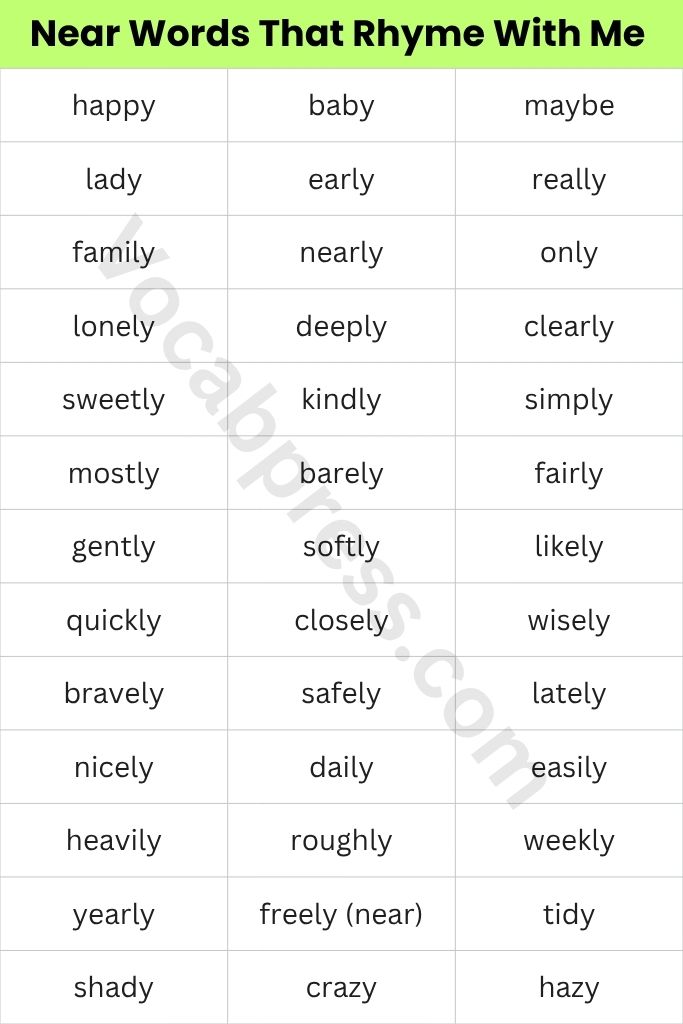
Near rhymes share a similar but not identical ending sound. They work well in songs and rap where the ear follows rhythm more than spelling.
- happy
- baby
- maybe
- lady
- early
- really
- family
- nearly
- only
- lonely
- deeply
- clearly
- sweetly
- kindly
- simply
- mostly
- barely
- fairly
- gently
- softly
- likely
- quickly
- closely
- wisely
- bravely
- safely
- lately
- nicely
- daily
- easily
- heavily
- roughly
- weekly
- yearly
- freely (near)
- tidy
- shady
- crazy
- hazy
- lazy
- daisy
- gravy
- navy
- wavy
- rainy
- breezy
- queasy
- greasy
- easy
- sleepy
- creepy
- cheeky
- sneaky
- leaky
- weekly
- nerdy
- wordy
- curly
- burly
- surly
- pearly
- girly
-erly (as in Beverly)
Why near rhymes work: In music and spoken poetry, the ear follows rhythm and stress, not spelling. A near rhyme keeps the flow moving without forcing an awkward perfect rhyme.
Slant Words That Rhyme With Me
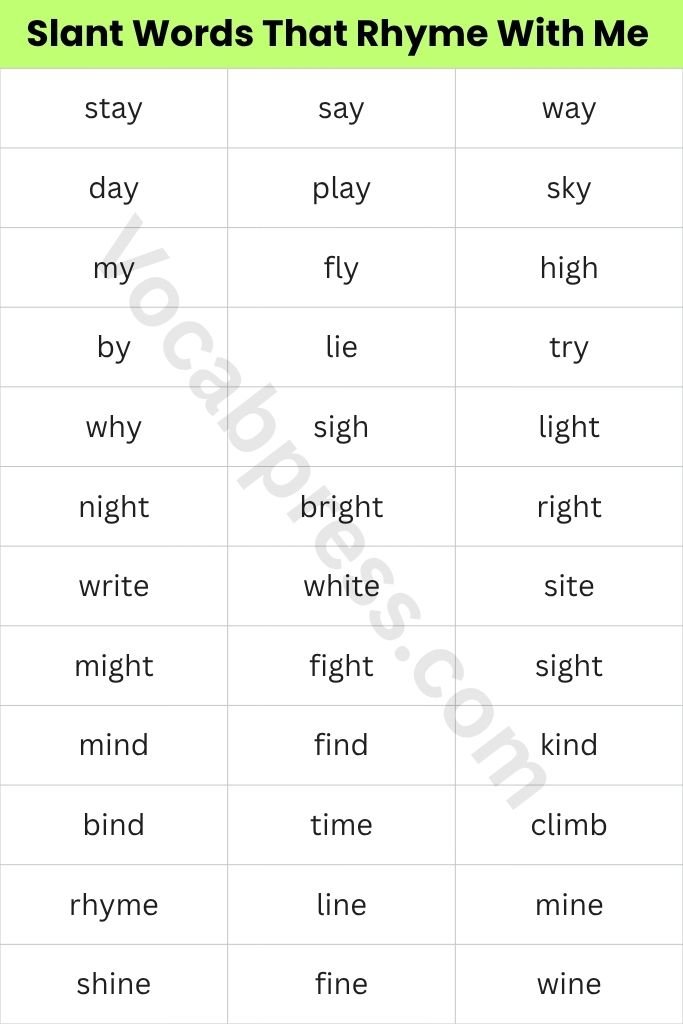
Slant rhymes share some sounds but not the full ending. Used widely in modern poetry, rap, and indie songwriting for a fresh feel.
- stay
- say
- way
- day
- play
- sky
- my
- fly
- high
- by
- lie
- try
- why
- sigh
- light
- night
- bright
- right
- write
- white
- site
- might
- fight
- sight
- mind
- find
- kind
- bind
- time
- climb
- rhyme
- line
- mine
- shine
- fine
- wine
- sign
When to use them: Use slant rhymes when a perfect rhyme feels forced or predictable. They give writing a more natural, conversational rhythm.
1 Syllable Words That Rhyme With Me
- be, see, we, he, she, key, tea, sea, fee, tree, free, three, bee, knee, glee, flee, pea, spree, Lee, decree
2 Syllables Words That Rhyme With Me
- agree
- degree
- trustee
- goatee
- emcee
- marquee
- carefree
- rupee
- tepee
- lychee
- settee
- whoopee
- trainee
- payee
- retiree
- standee
- oversee
- disagree
- foresee
3 Syllables Words That Rhyme With Me
- guarantee
- absentee
- referee
- devotee
- jamboree
- filigree
- jubilee
- detainee
- pedigree
- chickadee
- honoree
- escapee
- appointee
- franchisee
- mortgagee
- dungaree
- deportee
- repartee
Four or More Syllables Words That Rhyme With Me
- chimpanzee
- manatee (3, but long feel)
- Tennessee
- bourgeoisie
- potpourri
- Galilee
- Pharisee
- absentee (some accents stretch to 4)
Why this matters: One-syllable rhymes hit fast and hard. Longer rhymes add surprise, wit, or storytelling depth — especially in rap where landing a four-syllable rhyme on the beat shows real skill.
Rhymes for Me by Word Length
Short (2–4 letters):
- be, we, he, she, key, sea, tea, fee, pea, bee, glee, flee, tree, free, knee, Lee, the (not a rhyme), spree, three
Medium (5–8 letters):
- agree, degree, trustee, carefree, goatee, marquee, referee, trainee, rupee, tepee, lychee, whoopee, settee, payee
Long (9+ letters):
- guarantee, absentee, chickadee, jamboree, chimpanzee, filigree, pedigree, jubilee, honoree, deportee, repartee, franchisee, mortgagee, appointee, bourgeoisie, Tennessee
How to pick by length: Short words work in simple poems and children’s writing. Medium words fit song verses and captions. Long words bring humor, complexity, and punch to rap and creative writing.
Rhymes for Me Spelling Patterns and Pronunciation
The /iː/ sound hides behind several different spellings. This is why English learners and young readers sometimes get confused.
| Pattern | Examples | Notes |
| -e | me, be, he, she, we | Single letter, short word |
| -ee | free, tree, bee, knee, glee | Double E always says long-E |
| -ea | sea, tea, pea | Looks different, same sound |
| -ey | key, jockey (near), monkey (near) | Usually near rhyme |
| -ie | pie, tie | Does NOT rhyme — sounds like /aɪ/ |
| -y | happy, baby | Near rhyme only |
Pronunciation tip: To make the /iː/ sound, spread your lips slightly sideways as if smiling. Say: bee — sea — free — key. The mouth position barely changes between them. That is the same sound as “me.”
Common confusion: Words ending in -ie like “pie” or “tie” look like they might rhyme, but the vowel sound is completely different (/aɪ/ vs /iː/).
Rhymes for Me Homophones
Some rhyming words are also homophones — they sound identical to another word but carry a different meaning.
- sea / see — ocean vs. to look
- be / bee — to exist vs. an insect
- tea / tee — a drink vs. a golf tee
- key / quay — a lock tool vs. a wharf or dock
- flee / flea — to run away vs. a tiny jumping insect
- pea / pee — a green vegetable vs. informal urination
- free / three — not homophones, but beginners often mispronounce one as the other
- he / hee — a pronoun vs. a laughing sound
- glee / gli — no, just one spelling here
These pairs are useful for wordplay, puns, riddles, children’s books, and humorous poems.
Rhymes Word for Me With Meanings
Knowing what a word means helps you use it correctly, not just fit it in for the rhyme.
- free — not trapped, costs nothing, or able to make your own choices
- glee — strong, visible joy or excitement
- flee — to run away quickly, usually from danger
- decree — an official order made by someone in authority
- trustee — a person who manages money or property on behalf of someone else
- devotee — someone deeply passionate about a person, hobby, or cause
- jubilee — a significant anniversary celebration, usually 25 or 50 years
- filigree — delicate decorative metalwork made from twisted wire
- pedigree — the recorded family history of an animal or person
- marquee — a large outdoor tent for events, or a sign above a theater entrance
- emcee — a host or master of ceremonies
- spree — a short burst of intense activity, often celebration or spending
- absentee — someone who is missing when they were expected to be present
- referee — a person who enforces the rules in a sport or dispute
- repartee — quick, clever back-and-forth conversation or wit
- potpourri — a mixture of dried flowers for fragrance, or a mix of unrelated things
- dungaree — a type of heavy denim fabric, also plural for denim overalls
- rupee — the currency of India and several other countries
- tepee — a cone-shaped tent used by some Native American peoples
- lychee — a small sweet tropical fruit with rough red skin
- settee — a type of upholstered sofa or long bench
- deportee — a person who has been officially expelled from a country
- franchisee — a person or company that holds the rights to operate under a brand
- mortgagee — the lender in a mortgage agreement, usually a bank
- honoree — the person being honored at an event or ceremony
- escapee — someone who has escaped from a place of confinement
- chickadee — a small North American songbird with a distinctive call
- manatee — a large, gentle aquatic mammal, also called a sea cow
- chimpanzee — a highly intelligent primate native to Africa
- bourgeoisie — a term for the middle class, often in a political or social context
- Galilee — a historical region in northern Israel, referenced often in religious texts
- Pharisee — a member of an ancient Jewish sect, now used to mean a self-righteous person
- appointee — a person who has been officially chosen for a position or role
Example Sentences of Words That Rhyme With Me
Each sentence uses a different rhyming word naturally:
- She kept the spare key close to me.
- All I ever wanted was to be free.
- The old oak tree stood right beside the sea.
- Nobody agrees with me, and I am starting to see why.
- He earned his degree to prove something to himself and to me.
- The bees hummed softly near the pea plants all morning.
- She ran down the hill with pure glee toward the sea.
- A trustee called about the estate handling fee.
- That tiny chickadee sang its whole song only for me.
- The escapee hid underneath the marquee.
- I stirred my tea and thought about who I want to be.
- She won the award as honoree — nobody was prouder than me.
- The referee blew the whistle and turned to look at me.
- With quick repartee, she made everyone in the room agree.
- A wild chimpanzee grabbed the camera right in front of me.
- The manatee floated gently past, paying no attention to me.
- I planted a lychee tree — it took a year to finally see it grow.
- He was the absentee at the one meeting that mattered to me.
- The jubilee celebration stretched out as far as the eye could see.
- She wore old dungarees and danced beside me, completely carefree.
Rhyming Phrases for Me Worth Using
These phrases already carry the rhyme built in — drop them into captions, poems, or songs:
- wild and free
- meant to be
- just you and me
- let it be
- wait and see
- set me free
- plain to see
- underneath the tree
- beyond the sea
- the key to being free
- come with me
- the real me
- I can see clearly
- you and we
- born to be free
- agree with me
- all I need is we
- the storm and the sea
- lost in the debris
- what’s meant for me
Short Rhyming Lines for Me
Ready to drop into any poem or song:
- Under the tree, I let myself be.
- The sea called out, and the call was for me.
- She smiled with glee and handed me the key.
- I had to flee to finally feel free.
- Every degree meant nothing without being me.
- You and me — that is all I need to see.
- The bee sang a note, just for you and for me.
- Through the debris, something new started to be.
- The jubilee felt empty — you were not there with me.
- She crossed the sea just to finally agree.
Funny Words That Rhyme With Me
- My cat strongly disagrees with me. He wants the flea removed, but the vet charged a fee.
- I climbed a tree to drink my tea and sat directly on a bee. Not a great day for me.
- The chimpanzee handed me the key to its own private jamboree.
- I paid the fee, lost the tea, and still could not get the channel for free.
- She said, “Just be.” I said, “Be what exactly?” She said, “A chickadee.”
- The referee at my chess tournament turned out to be a manatee.
Mini Poems Rhymes for Me
Kids:
The little bee sat in the tree
and waved a tiny wing at me.
I waved back with so much glee,
and the bee buzzed off, happy and free.
Nature:
The wind moves quietly through the sea,
bending every branch of every tree.
I stand here with nowhere I need to be,
just breathing slow, just letting myself be free.
Friendship:
You called when no one else could see,
you stayed when others chose to flee.
That meant the whole wide world to me,
and now I know what friends can be.
Love:
You handed me a small gold key,
and said the door was meant for me.
I opened it and there could see
that you had built a home for we.
Motivational:
Every climb starts with just one knee,
every ocean started as a sea.
Whatever you are working hard to be,
just start right now — start here with me.
Funny:
I lost my only door key,
I spilled the last of the tea,
the dog chewed my degree,
but honestly — at least I am still free.
Words That Rhyme With Me Songs

Songwriting depends on how words feel when sung, not just how they read on paper.
Best for choruses:
- free — lands with emotional release, feels like a resolution
- be — simple, open, invites harmony
- see — clear and visual, good for hopeful moments
- we — creates unity and togetherness
- key — unlocking, arriving, resolving
Best for verses:
- degree, marquee, jubilee, devotee — more syllables fill more melodic space
- debris — unusual and emotionally heavy, works in bridge sections
- repartee — clever, good for witty or storytelling songs
Tips:
- Pair “me” with “free” in a chorus for emotional payoff — it feels earned
- Use “we” and “be” together when writing about relationships
- “Sea” and “tree” add natural imagery without sounding forced
- Avoid “detainee” and “mortgagee” in emotional ballads — too formal
- “Glee” and “spree” work well in upbeat pop or feel-good tracks
Rhymes for Me Rap
Rap rewards complexity and surprise. A basic “me/free” end rhyme is expected. The skill is in what surrounds it.
Multi-syllable stacking:
- I got a degree, you see, it is all part of me, the plan to be free, I guarantee.
Internal rhyme for me:
- She agreed with me, pleased to see I stood free at the marquee.
Near rhyme for me in flow:
- Running from the city, just me and the early morning, barely clearly seeing where I need to be.
Rhyme scheme idea: Use “me” to close every other bar. Alternate bars land on near rhymes like “really,” “clearly,” or “deeply.” This creates movement and stops the rhyme from becoming predictable.
Power words for rap:
- guarantee
- pedigree
- referee
- absentee
- emcee
- repartee
- appointee
- franchisee
- bourgeoisie
- Tennessee
- Galilee
- deportee
- potpourri
Rhymes for Me Captions
Instagram:
- Out here feeling wild and free — this view was made for me.
- Just the sea, the breeze, and me.
- Finally becoming the real me.
- Golden hour, just us, just we.
TikTok:
- POV: running free, just you and me.
- She said glow up — I said, watch me.
- No fee, no degree — just living free.
Funny captions:
- Bought the tea. Spilled the tea. Classic me.
- I agreed with myself. First time.
- Paid the entrance fee just to flee.
Romantic:
- You are where I want to be.
- Every moment, you and me.
- You handed me the key.
Words That Rhyme With Me Kids
Short words with clear sounds — these are the easiest for young children to learn and remember:
- me
- bee
- see
- tree
- free
- tea
- sea
- we
- he
- she
- knee
- pea
- Lee
- three
- glee
Reading practice sentences:
- The bee sat in the tree.
- Can you see the sea?
- Come and sit with me.
- We are happy and free.
- Look at the pea — it rolled to me.
- She has a bad knee but drank her tea.
Activity idea: Say “me” and ask a child to shout the first rhyming word that comes to mind. Write each one down. After ten words, count them together.
Phonics Rhymes for Me
The long-E sound (/iː/) is one of the earliest reading sounds children learn.
Patterns to teach:
- The -ee pattern — bee, see, tree, free, knee, glee. Double E always says long-E. No exceptions.
- The -e pattern — me, be, he, she, we. A single vowel at the end of a short word. Very common.
- The -ea pattern — sea, tea, pea. These look different but make the same sound.
Pronunciation practice:
Say each slowly: me — bee — sea — free — tree. The mouth barely moves between them. Lips stay slightly spread, almost like a tiny smile.
Spelling tip: If a word ends in -ee, it almost always rhymes with “me.” If it ends in a single -e at the end of a short word, it usually does too. The -ea pattern needs memorization because not all -ea words say long-E (for example, “bread” does not).
Common mistake: Words ending in -ie like “pie” or “tie” look similar but sound completely different. They say /aɪ/, not /iː/.
Words That Rhyme With Me Classroom Activities
Matching cards: Write rhyming pairs on index cards — me/tree, bee/sea, free/key, pea/tea — and have students match them face down like a memory game.
Spelling sort: Give students a list of long-E words and ask them to group by spelling: -ee words, -ea words, -e words.
Fill in the blank:
- The ___ flew into the tree. (bee)
- She gave the ___ to me. (key)
- We sailed across the ___. (sea)
- He sipped his ___ happily. (tea)
- She hurt her ___ at the game. (knee)
Rhyme chain: Start with “me” and go around the room. Each student adds a new rhyming word. No repeating. See how long the chain gets.
Write-a-line challenge: Each student writes one original sentence using a word that rhymes with “me” and reads it aloud.
Worksheet idea: Give a simple poem with blank spaces where rhyming words should go. Students fill in a word that rhymes with “me” to complete each line.
Rhymes for Me Writing Uses
In poems: Short perfect rhymes like “free,” “see,” and “be” carry emotional weight. They land with finality, which makes them strong at the end of a stanza or the closing line of a poem.
In stories: Rhyming phrases create rhythm that moves a reader forward. Picture books use this well — “Under the tree, just the bee and me” is easy for children to remember and repeat.
In speeches: A rhyming close sticks in the audience’s memory. Ending with “that is what it means to be free — to be truly, fully me” lands harder than a plain sentence.
In lyrics: The “me” rhyme acts as an anchor. It gives listeners something familiar to hold across verses and brings the ear home at the end of a line.
In rap: It is the building block. From simple punchlines to complex multi-syllable chains, “me” is one of the most productive end sounds in hip-hop writing.
Positive Words That Rhyme With Me
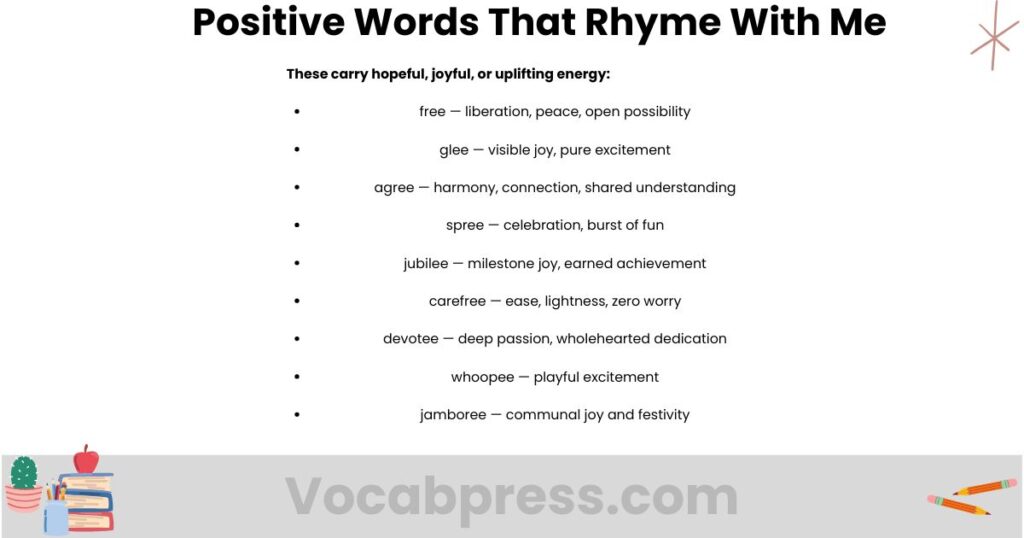
These carry hopeful, joyful, or uplifting energy:
- free — liberation, peace, open possibility
- glee — visible joy, pure excitement
- agree — harmony, connection, shared understanding
- spree — celebration, burst of fun
- jubilee — milestone joy, earned achievement
- carefree — ease, lightness, zero worry
- devotee — deep passion, wholehearted dedication
- whoopee — playful excitement
- jamboree — communal joy and festivity
Heavy or Negative Rhyming Words for Me
These carry weight, tension, or darkness — useful in serious writing:
- flee — escape, fear, running from something
- decree — authority, control, no choice given
- detainee — loss of freedom, confinement
- absentee — abandonment, being left, absence
- debris — wreckage, what remains after loss
- deportee — forced removal, displacement
- Pharisee — self-righteousness, hypocrisy
These are not words to avoid — they are words to use with intention. The weight they carry can make a poem or lyric far more powerful than a safe rhyme would.
Emotional Rhymes for Me
Love and romance:
- be — as in “all I want is for you to be here with me”
- free — as in “you set me free from everything I feared”
- we — togetherness, choosing each other
- sea — the vastness of deep feeling
- key — unlocking something hidden in the heart
Sadness and longing:
- flee — running away from pain
- debris — what is left after something ends
- absentee — the ache of someone not being there
Friendship:
- agree — mutual understanding and respect
- glee — shared laughter and happiness
- we — belonging, not being alone
Inspiration and hope:
- free — reaching your potential, breaking limits
- jubilee — celebrating how far you have come
- carefree — finally releasing the weight you carried
Best Words That Rhyme With Me by Category
| Category | Best Choices |
| Kids and beginners | bee, tree, sea, tea, pea, we, free, he, she, knee |
| Poetry | free, glee, sea, flee, be, decree, jubilee, debris |
| Rap | guarantee, marquee, emcee, degree, pedigree, absentee, repartee, deportee |
| Song chorus | free, be, see, we, key |
| Song verse | jubilee, devotee, marquee, debris, filigree |
| Instagram captions | free, sea, glee, be, we |
| Creative writing | filigree, jubilee, chickadee, debris, repartee |
| Classroom and phonics | bee, see, tree, fee, knee, pea, tea |
| Storytelling | flee, decree, devotee, marquee, escapee |
| Worksheets | bee, tree, sea, key, tea, pea, knee, he, she |
| Humor and puns | chimpanzee, manatee, chickadee, jamboree, bourgeoisie |
Common Mistakes
Using words that only look like rhymes:
- “mine” — looks related but the vowel is /aɪ/, not /iː/
- “pie” — ends in -ie but sounds like /aɪ/, not “me”
- “they” — the -ey here says /eɪ/, not long-E
Overusing the same pairing: Pairing “me” with “free” once is powerful. Doing it four times in one poem feels lazy. Rotate through “be,” “see,” “glee,” and “we” to keep the writing alive.
Treating near rhymes as perfect rhymes: “Really” and “clearly” are near rhymes. They work in songs and rap. In formal poetry, careful readers notice the gap. Know which kind of writing you are doing before deciding which to use.
Forcing long words where they break the tone: “Chimpanzee” is a brilliant rhyme word in a funny poem or rap punchline. It does not belong in a love ballad unless you want the laugh.
Ending every single line with “me”: When every line lands on the same word, it stops feeling like poetry. It starts feeling like a list. Vary the end words and let “me” appear where it has the most impact.
Words to Be Careful With
- debris — often mispronounced as DEB-ris. The correct pronunciation is deh-BREE. Avoid it in pieces meant to be read aloud by beginners or non-native speakers.
- bourgeoisie — rhymes perfectly but carries heavy class and political meaning. Do not drop it in casually without knowing the weight.
- marquee — works well in rap and captions. Sounds odd in a children’s poem.
- detainee — carries serious political and legal meaning. Use with real intention, not just for the rhyme.
- calligraphy — does not actually rhyme with “me.” Some rhyme sites list it incorrectly. Skip it entirely.
- Pharisee — carries religious and historical context. Know what you are saying before you use it.
FAQs
1. How do I choose the best word that rhymes with “me”?
Start by thinking about what you want to say. If you want a happy feeling, words like free, glee, and we work well. For nature, tree and sea fit naturally. Pick a word that matches your message instead of using a rhyme just because it sounds similar.
2. Are near rhymes okay in poems and songs?
Yes. Near rhymes are common in modern songs, rap, and spoken poetry. They help your writing sound more natural when a perfect rhyme feels forced. In school poetry, perfect rhymes are often preferred, but both styles have their place.
3. What are the easiest rhyming words for young children?
Simple words like bee, tree, see, tea, sea, free, we, and key are great for early readers. They are easy to say, easy to remember, and help children hear the long E sound.
4. Why do some words rhyme even though they are spelled differently?
English uses different letter patterns to make the same sound. For example, me, tree, sea, and key all end with the long E sound, even though they have different spellings. Listening to the sound is more important than looking only at the letters.
Summary
The word “me” gives you one of the most productive rhyme pools in the English language. From short everyday words like “be,” “see,” and “free” to long creative choices like “chimpanzee,” “jubilee,” and “repartee,” the options suit every kind of writing — children’s books, love songs, classroom phonics, rap verses, Instagram captions, and serious poetry.
The key is matching the right rhyme to the right moment. Short words hit hard and feel emotional. Long words bring wit, surprise, and rhythmic complexity. Near rhymes keep things flowing naturally when a perfect rhyme feels stiff. Use whichever serves the writing — not just whichever sounds clever. That is what makes words that rhyme with me actually work on the page.

It’s Afini, I am the author at Vocab press, a website focused on animal facts with clear visuals and simple guides. I research and share accurate, easy-to-understand information for readers of all ages. My goal is to make learning about animals fun, trustworthy, and simple. I follow fact-based writing and keep content updated, helpful, and people-first. Thank you for reading.