Finding the right rhyming word can change everything — a flat poem becomes memorable, a song lyric clicks into place, a caption goes from boring to shareable. “Home” ends with the “-ohm” sound, and once you lock onto that, a surprisingly large list opens up.
This article covers every usable rhyme — perfect, near, and slant — with meanings, examples, poems, rap ideas, and classroom tools. Whether you are a songwriter, a teacher, a kid, or just someone stuck on a verse, you will find what you need here.
Quick Answer: Best Rhymes for Home
These are the most common and natural-sounding rhymes:
- foam
- roam
- dome
- comb
- gnome
- chrome
- loam
- poem
- tome
- Rome
- Nome
- catacomb
- metronome
- palindrome
- velodrome
- hippodrome
- aerodrome
- gastronome
- chromosome
- syndrome
- monochrome
- rhizome
- Jerome
- microdome
- superdome
Quick sentences:
- The waves left white foam along the rocks.
- She chose to roam rather than stay in one place.
- The city’s glass dome caught the morning light.
- He wrote a poem for his mother’s birthday.
- The old car had polished chrome trim.
Perfect Words That Rhyme With Home
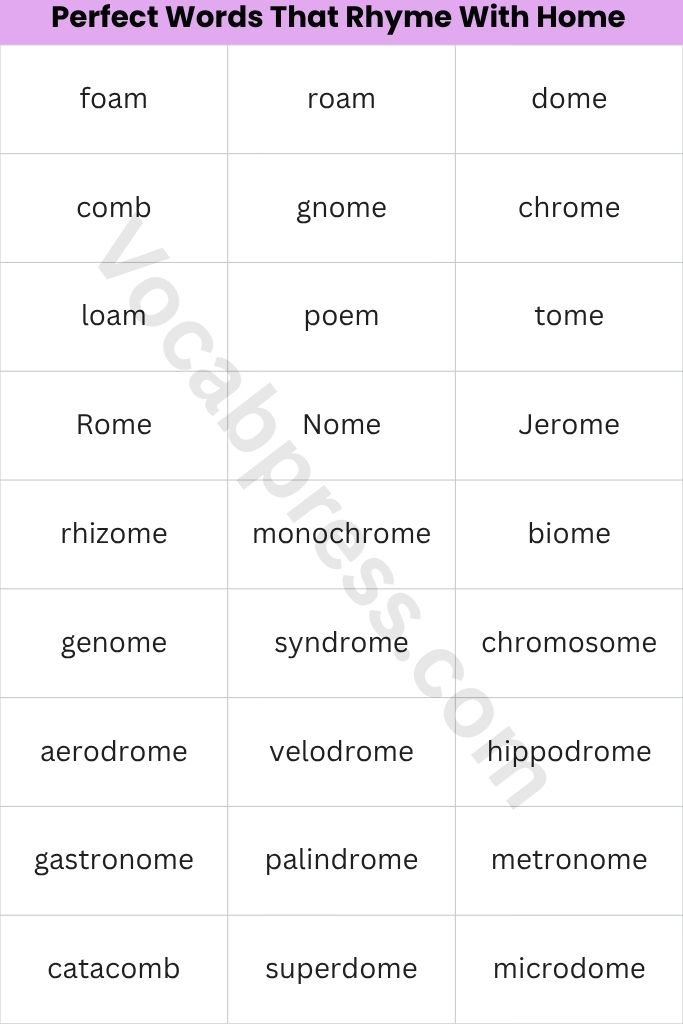
These match the “-ohm” sound exactly. Every word here rhymes cleanly with home when spoken aloud.
Common Rhymes for Home:
- foam — the bubbly, light layer on water, coffee, or soap
- roam — to wander freely without a fixed destination
- dome — a rounded, curved roof or top of a structure
- comb — a toothed tool for hair; also means to search carefully through something
- gnome — a small mythical creature from folklore, often shown as a bearded figure
- chrome — a shiny, silver-like metallic coating
- loam — soft, dark, fertile soil that holds moisture well
- poem — a piece of writing that uses rhythm, imagery, or rhyme to express ideas
- tome — a very large, heavy, serious book
- Rome — the historic capital city of Italy
Less common but solid:
- Nome — a city in western Alaska, well-known for the Iditarod race
- Jerome — a proper name; also a historic mining town in Arizona
- rhizome — an underground plant stem that spreads horizontally, like ginger root
- monochrome — using only one color or shades of a single color
- biome — a large natural region defined by its climate and plant life, like a desert or rainforest
- genome — the complete set of genetic material inside an organism
- syndrome — a cluster of symptoms that regularly appear together in a condition
- chromosome — a thread-like structure inside cells that carries DNA
- aerodrome — an older or smaller type of airfield or airport
- velodrome — a stadium built specifically for cycling races
- hippodrome — an ancient arena for horse and chariot races; also used for theaters
- gastronome — a person who takes great interest in fine food and cooking
- palindrome — a word or sentence that reads the same forward and backward
- metronome — a device that ticks at a set speed to help musicians keep time
- catacomb — an underground tunnel network historically used for burial
- superdome — a very large, covered stadium
- microdome — a small dome-shaped structure, used in architecture and design
Near Words That Rhyme With Home
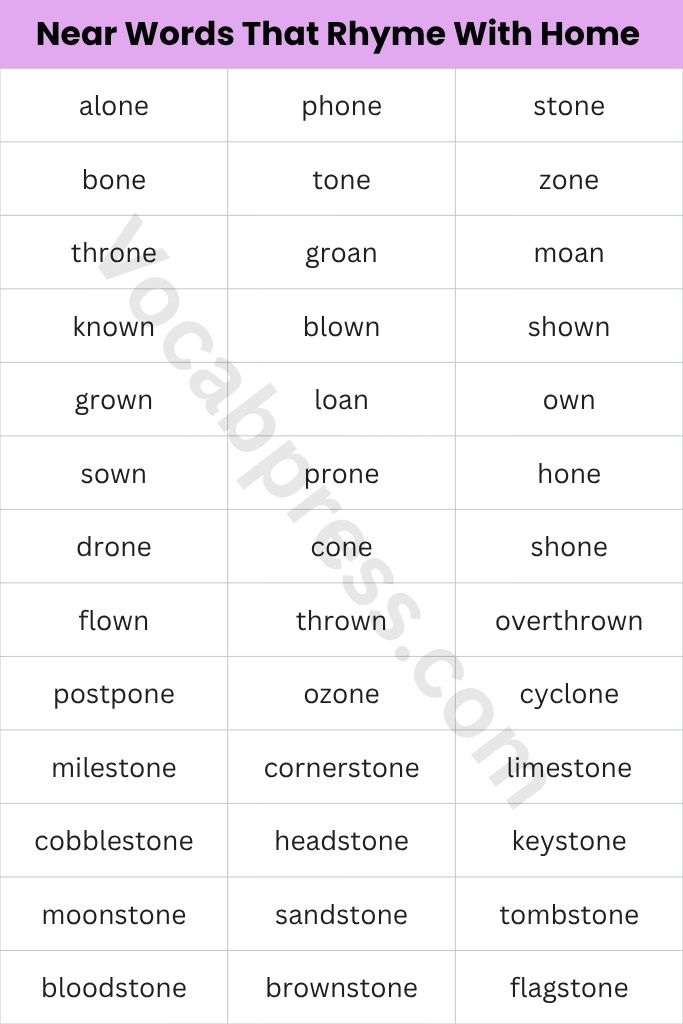
Near rhymes share the long O vowel sound but end in “-n” instead of “-m.” They do not match perfectly but feel natural in songs and rap because the vowel carries the weight.
- alone — without others; isolated
- phone — a communication device
- stone — a hard, solid mineral material
- bone — the hard structure inside the body
- tone — the quality or character of a sound or color
- zone — a defined area or region
- throne — a ceremonial chair for royalty
- groan — a deep sound of pain or frustration
- moan — a low sound of discomfort or longing
- known — recognized, understood, or familiar
- blown — pushed by wind; past tense of blow
- shown — displayed or made visible
- grown — developed or increased over time
- loan — money borrowed that must be repaid
- own — to possess something
- sown — seeds that have been planted
- prone — lying face down; also likely to do something
- hone — to sharpen a skill or a blade
- drone — a low buzzing sound; also an unmanned flying device
- cone — a shape that is round at the bottom and pointed at the top
- shone — past tense of shine
- flown — past tense of fly
- thrown — past tense of throw
- overthrown — removed from power by force
- postpone — to delay something to a later time
- ozone — a gas layer in the atmosphere that absorbs ultraviolet radiation
- cyclone — a powerful rotating storm system
- milestone — an important point in progress or development
- cornerstone — the most important or foundational element of something
- limestone — a sedimentary rock made mostly of calcium carbonate
- cobblestone — a rounded stone used to pave roads in older towns
- headstone — a stone marker placed at the head of a grave
- keystone — the central stone of an arch; also the most important part of a plan
- moonstone — a gemstone with a soft, glowing appearance
- sandstone — a rock formed from compressed sand particles
- tombstone — a stone marking a burial site
- bloodstone — a dark green gemstone with red spots
- brownstone — a type of reddish-brown sandstone used in urban buildings
- flagstone — a flat stone used for paving paths or patios
Slant Words That Rhyme With Home
Slant rhymes share some sounds but do not fully match. These are used in experimental poetry or rap for variety and surprise.
- come — sounds like “-um,” shares the M ending
- some — same issue; looks like a rhyme but sounds different
- drum — ends in “-um,” but the M sound links loosely
- room — ends in “-oom,” closer in feel than in sound
- bloom — same “-oom” sound; used in nature poetry alongside home
- gloom — dark, dim, heavy atmosphere
- doom — a terrible outcome or fate
- womb — the place where a baby develops; creates an emotional slant connection to home
- tomb — a burial chamber; rhymes with womb, not home, but often used nearby in dark verse
Rhymes for Home by Number of Syllables
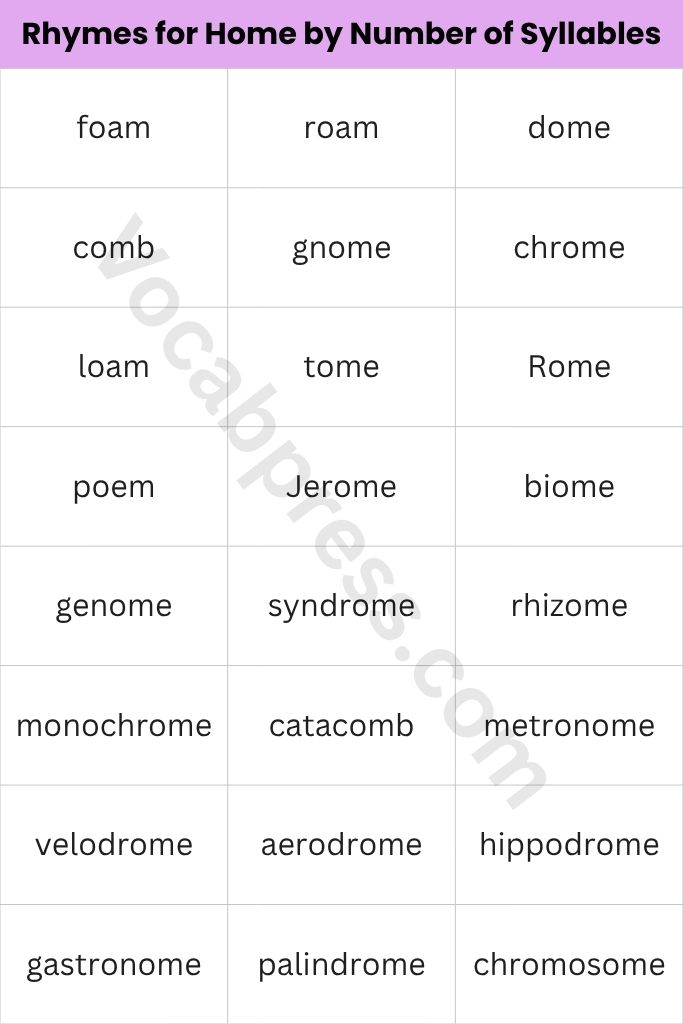
1 Syllable Rhymes for Home
- foam
- roam
- dome
- comb
- gnome
- chrome
- loam
- tome
- Rome
- poem (can function as one syllable in lyrics)
2 Syllables Rhymes for Home
- Jerome
- biome
- genome
- syndrome
- rhizome
- monochrome (three, but flows like two in speech)
3 Syllables Rhymes for Home
- catacomb
- metronome
- velodrome
- aerodrome
- hippodrome
- gastronome
- palindrome
- chromosome
- superdome
4 Syllables Rhymes for Home
- chromosome (some pronunciations stretch it)
- hippodrome (hip-oh-drome)
- aerodrome (air-oh-drome)
Words That Rhyme With Home by Word Length
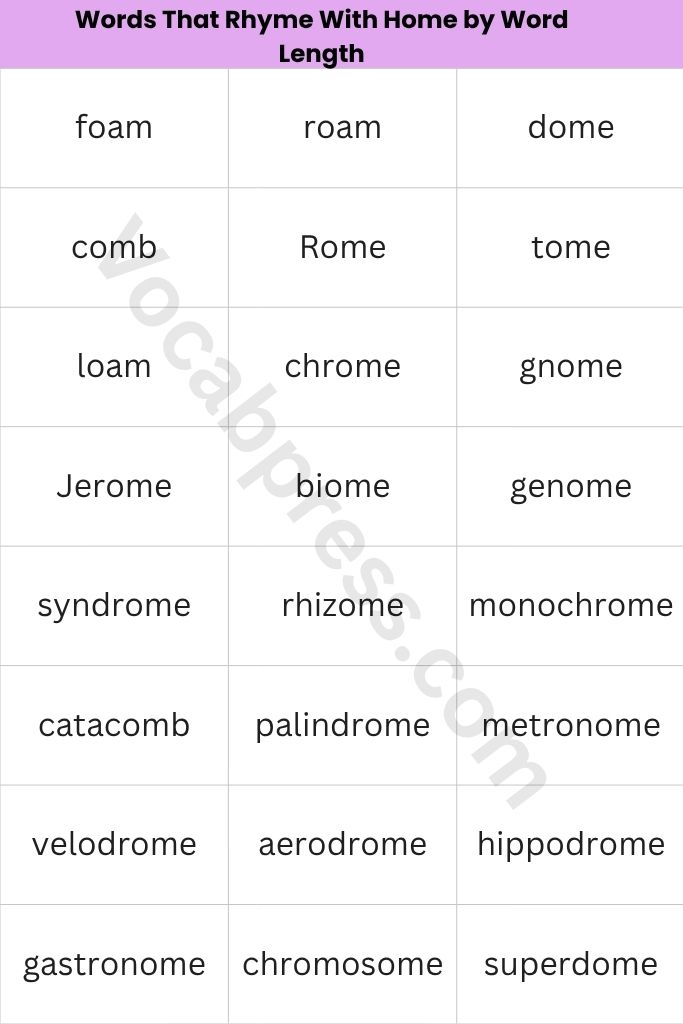
Short Words (3–5 letters)
- foam
- roam
- dome
- comb
- Rome
- tome
- loam
Medium Words (6–9 letters)
- chrome
- gnome
- Jerome
- biome
- genome
- syndrome
- rhizome
- monochrome
Long Words (10+ letters)
- catacomb
- palindrome
- metronome
- velodrome
- aerodrome
- hippodrome
- gastronome
- chromosome
- superdome
Rhymes for Home Spelling Patterns and Pronunciation
The “-ome” spelling appears in many words, but not all of them rhyme with home. This is one of the trickiest things about English spelling.
Words spelled “-ome” that DO rhyme with home (long O sound):
- dome
- foam
- gnome
- chrome
- tome
- loam
- poem
- comb
- roam
Words spelled “-ome” that do NOT rhyme with home (short U sound):
- come
- some
- become
- welcome
- overcome
- income
- outcome
- troublesome
- handsome
- awesome
- wholesome
- tiresome
- lonesome
- bothersome
- quarrelsome
- cumbersome
The vowel in “come” sounds like the “u” in “cup.” The vowel in “home” sounds like the “o” in “go.” Same spelling, completely different sound.
Silent letters to know:
- gnome — the G is silent; say “nohm”
- comb — the B is silent; say “kohm”
- rhizome — the H is nearly silent; say “RY-zohm”
- chromosome — say “KROH-muh-zohm”
Words That Rhyme With Home With Meanings
foam — light, bubbly mass formed when air mixes with liquid; found on waves, soap, and coffee
roam — to travel or move without a fixed plan or destination
dome — a rounded, hemispherical roof or ceiling on a building or structure
comb — a flat or curved tool with teeth used to detangle or style hair; also to search an area carefully
gnome — a small creature from European folklore, typically shown as an old man with a beard; also a garden ornament
chrome — a hard, shiny coating applied to metal surfaces; also refers to the Google web browser
loam — a high-quality soil made from a mix of sand, silt, and clay that drains well and supports plant growth
poem — a piece of literary writing that uses rhythm, sound, or image to express emotion or ideas
tome — a large, thick, and often scholarly book
Rome — the capital of Italy and one of the world’s oldest cities
Nome — a city on the western coast of Alaska, famous for being the finish line of the Iditarod sled race
Jerome — a male given name of Greek origin; also a well-preserved historic mining town in Arizona
rhizome — a horizontal underground plant stem that produces shoots above and roots below, like ginger or turmeric
biome — a major ecological community defined by its dominant plant life and climate, such as tundra, grassland, or tropical forest
genome — the full set of DNA instructions found inside every cell of an organism
syndrome — a recognizable group of symptoms or characteristics that occur together and define a condition
chromosome — a structure made of DNA and proteins inside a cell nucleus that carries inherited traits
aerodrome — a small or early airfield designed for light aircraft
velodrome — an oval indoor or outdoor cycling track with banked curves
hippodrome — in ancient Greece and Rome, an outdoor track for horse and chariot racing; in modern usage, a large theater or arena
gastronome — someone with refined knowledge and appreciation of good food
palindrome — a word, phrase, or number that reads the same in both directions, such as “level” or “racecar”
metronome — a mechanical or electronic device that produces regular beats to help musicians maintain a consistent tempo
catacomb — an underground cemetery made up of tunnels and chambers, especially those used in ancient Rome
monochrome — a color scheme using different shades of a single color, often black and white
superdome — a very large, enclosed stadium, usually with a domed roof
microdome — a small dome structure used in specialty architecture or eco-housing
Example Sentences Rhymes for Home
- The dishwasher left a ring of foam around the inside of the bowl.
- He wanted to roam the coastline before settling anywhere.
- Tourists gathered beneath the painted dome of the cathedral.
- She used a wide-tooth comb to work through her wet hair.
- The neighbor’s concrete gnome had been there since the 1970s.
- The chrome on the vintage motorcycle was polished to a mirror finish.
- Good loam crumbles in your hand and smells faintly like rain.
- Nobody touched the thick tome on the top shelf of the library.
- The catacomb tour took visitors twenty feet below the streets of Paris.
- She kept a metronome on the piano and practiced with it every morning.
- A palindrome like “kayak” reads exactly the same from both ends.
- Scientists mapped the entire human genome over more than a decade.
- The cycling final was held in a velodrome built for the regional games.
- A syndrome does not name a single disease — it describes a pattern of symptoms.
- The biome in the northern tundra supports very few plant species.
- He read every room in the museum but lingered longest in the monochrome photography exhibit.
- The rhizome of ginger spreads underground and keeps producing new shoots each season.
Rhyming Phrases for Home
These phrases use rhyming words together naturally in speech and writing:
- sea foam — the frothy white bubbles left by ocean waves
- free to roam — having the freedom to go wherever you want
- under the dome — beneath a large, enclosed structure; also a feeling of being covered or contained
- no place like home — the most widely known phrase using this rhyme
- far from home — emotional or physical distance from where you belong
- carved from stone (near rhyme) — describes something built to last
- chrome and bone (near rhyme pair) — sharp contrast between artificial shine and natural rawness
- lost and alone (near rhyme) — emotional isolation, useful in ballads
- a poem called home — poetic phrase connecting writing to belonging
- sleep like a gnome — funny phrase meaning to sleep heavily in a small, cozy space
Short Rhyming Lines for Home
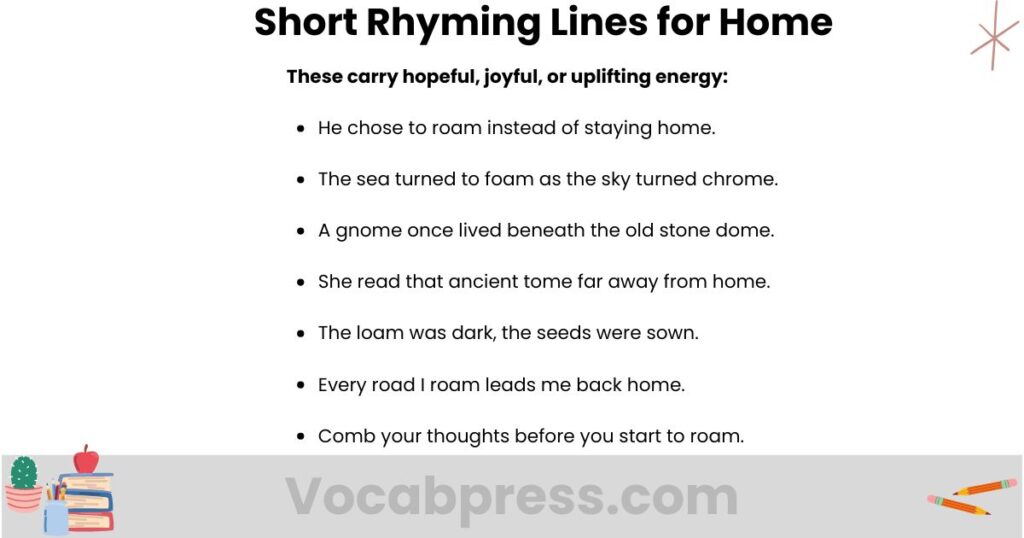
Ready to use in poems or songs:
- He chose to roam instead of staying home.
- The sea turned to foam as the sky turned chrome.
- A gnome once lived beneath the old stone dome.
- She read that ancient tome far away from home.
- The loam was dark, the seeds were sown.
- Every road I roam leads me back home.
- Comb your thoughts before you start to roam.
- The whole city glowed beneath the dome.
Funny Words That Rhyme With Home
- A gnome left home to search for a comb but lost it somewhere near a chrome dome.
- My dog loves to roam but hates the foam in his bath at home.
- I bought a chrome gnome and placed it next to my metronome — it keeps perfect time, apparently.
- The palindrome “racecar” drove right back home the same way it left.
Mini Poems
For kids:
A little gnome sat by a stone,
He missed his friends, he felt alone.
He grabbed his comb, put on his coat,
And walked back home through morning foam.
Nature:
The horses love to freely roam
Across the loam where wildflowers grow,
Beneath a sky of polished chrome,
This open field becomes their home.
Friendship:
No matter where your feet may roam,
The place you’re loved becomes your home.
It is not a dome, it is not a throne,
It is just where you are not alone.
Motivational:
You do not need a catacomb to hide.
You do not need a velodrome to ride.
Just pick a path and start to roam,
And wherever your heart lands, call it home.
Love:
You are the poem I never planned to write,
The dome above me blocking out the night,
Wherever I roam, whatever road I face,
Your voice is what makes any place feel home.
Words That Rhyme With Home for Songs
Songs live on vowel sounds, and the long O in “home” is one of the best because it opens the throat and holds a note.
Best words for slow, emotional songs:
- roam
- alone
- known
- grown
- shown
- foam
- loam
These create a sense of longing, journey, and return — themes that make listeners feel something.
Best words for upbeat or pop songs:
- dome
- chrome
- gnome
- foam
These are short, punchy, and land cleanly on a beat without dragging the melody.
Tip: In a chorus, use your cleanest, most familiar rhyme — roam, foam, or dome. Save longer words like metronome or palindrome for a verse where you have syllables to fill.
Words That Rhyme With Home for Rap
Rap uses rhyme differently. Syllables, timing, and internal rhyme matter as much as the end word.
Multi-syllable combinations:
- chrome dome
- roam alone
- catacomb / far from home
- palindrome / finding home
- metronome / never known
- syndrome / overthrown
- genome / stone throne
Internal rhyme example:
Left the foam behind, said I’m done with what I’ve known / grabbed the chrome and hit the road, never looking back at home.
Advanced stacking: Try ending line one with “catacomb” and line two with “far from home.” The syllables land on the same beat pattern, and the meaning carries emotional weight.
Flow tip: Near rhymes like “alone,” “stone,” and “phone” blend into “-ohm” rhymes when rapped at speed. The listener’s ear fills in the gap. Use this to your advantage.
Home Rhymes for Captions
Travel / adventure:
- “Born to roam, just far from home.”
- “Sea foam and open roads.”
- “Every city feels like a dome when you look up.”
- “Wherever I roam, I carry home with me.”
Funny:
- “Chrome nails, gnome energy.”
- “Roaming around like I own the foam.”
- “Bought a gnome. Named him Jerome.”
Romantic:
- “Wherever you are becomes my home.”
- “You make every place feel less alone.”
- “You are the poem I keep coming back to.”
Aesthetic / calm:
- “Loam and rain and the smell of home.”
- “Soft as foam, warm as home.”
- “Monochrome mornings and quiet roads.”
Kids Rhymes for Home
Simple words for young readers learning to rhyme:
- foam — the bubbles in your bath or on a wave
- roam — walking around and exploring freely
- dome — the round top of a building, like a snow globe shape
- comb — what you run through your hair in the morning
- gnome — a funny little magical figure with a pointy hat
Reading practice sentences:
- The gnome lives far from home.
- I found my comb under the dome.
- Look at all that foam!
- She likes to roam near her home.
- The big dome is close to home.
These sentences all use the same “-ohm” sound pattern, which helps young readers recognize it by ear before they can explain it.
Phonics Rhymes for Home
The pattern: “-ome” with a long O sound
Sounds like: /oʊm/
Words that follow the pattern:
- home — /hoʊm/
- foam — /foʊm/
- dome — /doʊm/
- roam — /roʊm/
- gnome — /noʊm/
- comb — /koʊm/
- loam — /loʊm/
- chrome — /kroʊm/
- tome — /toʊm/
- poem — /poʊm/ (when used as one syllable)
Tricky exceptions to teach:
- “come” and “some” look like rhymes but sound like “-um” — teach this contrast early
- “comb” has a silent B — students often try to say “comb-b”
- “gnome” has a silent G — sounds like “nome”
Phonics activity:
Say a word out loud. Students clap once if it rhymes with home, stay still if it does not. Use: foam, come, dome, some, roam, drum, gnome, welcome. This trains the ear, not just the eye.
Classroom Activities Rhymes for Home
Matching card game:
Write each rhyming pair on separate cards. Students match them: home → foam, dome → roam, chrome → gnome. Works for grades 1 through 3 and takes about fifteen minutes to run.
Fill in the blank:
- He picked up his ___ and started to ___.
- The round ___ was built near the ___ sea.
Students choose from a printed word bank.
Sorting activity: Give students a mixed list. They sort into two columns — “Rhymes with home” and “Does not rhyme with home.” Include trap words like “come,” “some,” and “welcome” to build thinking skills.
Two-line rhyme writing: Ask every student to write just two lines using any word from the rhyme list. Even reluctant writers can manage two lines.
Picture and word match: Draw or print pictures of a dome, a comb, sea foam, and a gnome. Students write the correct word underneath each picture and circle the letters that make the “-ohm” sound.
Positive Words That Rhyme With Home
These carry upbeat, hopeful, or peaceful energy:
- roam — freedom, adventure, open possibility
- foam — lightness, play, natural beauty
- chrome — shine, polish, ambition
- dome — shelter, grandeur, safety
- loam — growth, nourishment, the earth
- poem — art, expression, creativity
- biome — wonder, ecology, life in balance
- genome — science, potential, the building blocks of living things
Negative Words That Rhyme With Home
These words carry weight and are useful in writing that explores darkness, loss, or difficulty:
- catacomb — death, burial, underground isolation
- syndrome — illness, struggle, a pattern of pain
- tome — something heavy, overwhelming, hard to get through
- gnome (in dark fantasy) — eerie, underground, threatening
These are not words to avoid. They give poems and songs emotional depth.
Emotional Rhymes for Home
For love writing:
- home
- roam
- poem
- known
- shown
- grown
- alone
The pairing of “home” and “alone” carries enormous emotional weight. One means belonging, the other means isolation — and love songs use this contrast constantly.
For grief or sadness:
- catacomb
- alone
- unknown
- groan
- moan
For hope and inspiration:
- roam
- foam
- chrome
- genome
- dome
For heartbreak:
- overthrown
- unknown
- grown
- alone
- groan
Best Rhymes by Category
Kids and beginners:
- foam
- roam
- dome
- comb
- gnome
Poetry:
- loam
- dome
- roam
- poem
- catacomb
- chromosome
- monochrome
Songs:
- roam
- alone
- foam
- known
- grown
- shown
Rap:
- chrome
- catacomb
- palindrome
- metronome
- dome
- syndrome
Social media captions:
- roam
- foam
- gnome
- chrome
- Jerome
Storytelling and fiction:
- tome
- catacomb
- dome
- gnome
- palindrome
Phonics and classroom:
- foam
- dome
- comb
- roam
- gnome
Creative and academic writing:
- palindrome
- catacomb
- syndrome
- gastronome
- genome
- chromosome
- monochrome
- rhizome
- aerodrome
Common Mistakes
Using “come” or “some” as rhymes for home: They look identical in spelling pattern but sound nothing alike when spoken. Never use them in performed or recorded work.
Mispronouncing “gnome”: The G is completely silent. If you say “guh-nome,” the rhyme breaks.
Mispronouncing “comb”: The B is silent. It sounds like “kohm,” not “comb-b.”
Treating near rhymes as perfect rhymes in formal work: “Alone” and “home” work in songs and rap but will not pass in a strict rhyme scheme for school or a structured poem.
Repeating the same rhyme word: Using “roam” in every single verse becomes predictable. Rotate through foam, dome, chrome, and gnome.
Forcing rare words for style: “Palindrome” and “gastronome” are impressive, but if they do not fit the meaning, they sound forced. Use them when they earn their place.
Words to Avoid Using as Rhymes for Home
These words look similar but do not rhyme when spoken:
- come — sounds like “-um”
- some — sounds like “-um”
- become — sounds like “-um”
- welcome — completely different ending
- awesome — no match at all
- income — “-um” ending
- outcome — “-um” ending
- overcome — “-um” ending
- troublesome — “-um” ending
- handsome — “-um” ending
- wholesome — “-um” ending
- tiresome — “-um” ending
- lonesome — “-um” ending
- bothersome — “-um” ending
- cumbersome — “-um” ending
- quarrelsome — “-um” ending
Every word in this list ends in the “-sum” or “-zum” sound. They rhyme with each other — not with home.
Read also:
Words That Rhyme With Me: Easy, Perfect, Near & Fun Words with Examples
FAQs
Does “poem” really rhyme with “home”?
In casual speech and in song lyrics, yes. When said quickly, “poem” contracts into roughly one syllable — “pohm” — and the rhyme lands cleanly. In formal poetry with strict meter, “poem” is usually two syllables, so it works better as a near rhyme. How you use it depends on whether you are writing for the eye or the ear.
What is the easiest rhyme for home that a young child can use?
“Foam” is the easiest — one syllable, familiar from bath time and ocean trips, and it fits naturally into almost any sentence. “Gnome” is also popular with kids because the image is fun and slightly silly.
Can “alone” rhyme with “home” in a song?
Yes, and it is one of the most emotionally powerful combinations in popular music. It is technically a near rhyme because “alone” ends in “-n” and “home” ends in “-m.” But the long O vowel in both words carries through the singing, and most listeners feel the rhyme rather than analyze it.
What rhymes with “home” for a rap verse that needs longer words?
“Catacomb,” “palindrome,” “metronome,” and “chromosome” all work well. They give you three or four syllables to ride across a beat and land on the same “-ohm” ending. A strong pairing: end line one with “catacomb” and line two with “far from home.” The syllable patterns match, the meaning hits hard, and it sounds deliberate rather than accidental.
Summary
Words that rhyme with home range from the simple — foam, roam, dome, comb, gnome — to the advanced — catacomb, palindrome, chromosome, velodrome. Near rhymes like alone, stone, and phone expand the list even further, especially for songwriting and rap where the long O vowel matters more than an exact ending.
Watch out for look-alike traps. Words like “come,” “some,” and “become” share the “-ome” spelling but sound completely different. Always say your rhyme out loud before you commit to it. The ear is the final judge, not the eye.
Whether you are helping a child learn phonics, finishing a song lyric at midnight, or putting together a poem for someone you love, this list gives you more than enough to work with. Pick the word that fits the moment, say it aloud, and trust what sounds right.

It’s Afini, I am the author at Vocab press, a website focused on animal facts with clear visuals and simple guides. I research and share accurate, easy-to-understand information for readers of all ages. My goal is to make learning about animals fun, trustworthy, and simple. I follow fact-based writing and keep content updated, helpful, and people-first. Thank you for reading.